I'm going off to Compton Durville for an 8-day retreat starting on Friday afternoon, so I'll be leaving a little hole in the blogosphere till next month, effectively. See you then!
Powered by Qumana
I'm going off to Compton Durville for an 8-day retreat starting on Friday afternoon, so I'll be leaving a little hole in the blogosphere till next month, effectively. See you then!
Powered by Qumana
In the latest (July 14) post in her Lectionary Blog, Sarah Dylan Breuer quotes at length from an excellent Christianity Today interview with the Rt. Rev. Dr. David Zac Niringiye, Assistant Bishop of Kampala in the Church of Uganda. I'm not going to quote it again here, - I'd strongly encourage you to read it in full - but Dr Niringiye's point is that he has "...come to the conclusion that the powerful, those at the center, must begin to realize that the future shape of things does not belong to them. The future shape of things is on the periphery. The future shape of things is not in Jerusalem, but outside. It is Nazareth. It is Antioch."
I've been thinking a lot about being here in Wool. This is a village in rural Dorset, hidden away from what makes 21st century Britain the way it is, just a dot on the map between Poole and Weymouth. The centre it is not. Yet even years ago, Jan and I were certain that the Lord was calling us here, and that certainty has only grown in the intervening time.
It is very easy, when one reads of the things going on in the church nationally and internationally, the big festivals, the major inner-city evangelism programmes, the National Centre for This and the International Forum for Something Else, to feel a bit irrelevant, as though God had far better things to do than pay much attention to Wool.
Dr Niringiye is right, though. Jesus was from Nazareth, much to Nathaniel's disgust. The Lord's Anointed never was crowned King of the Jews. The closest he got was an ironic label on the Cross where he died, outside the city walls, and when he rose again on the third day, disbelief and rumours. The beginning of the baby church's cross-cultural push, without which it might (had God allowed it) have remained an obscure Jewish sect in the footnotes of history, was in Antioch, not in Jerusalem. St Francis (with the exception of some notable journeys) and St Clare spent all their lives in and around Assisi, not in Rome. Martin Luther, the child of obscure country folk, lived and worked his whole adult life in Wittenberg, not in Paris or Berlin.
The cosmos swung on the pivot of Bethlehem, 2000-odd years ago, far away from the might of Rome or the conceit of Jerusalem, and it was a bunch of tatty local shepherds who brought the first worship to the Saviour of the World. Even now, we don't know their names.
It is not for us to try and assess the importance of what God calls us to do, or where he calls us to serve. Our only answer is the answer Jesus gave to Peter in John 21, "...what is that to you? Follow me!"
Powered by Qumana
Mary Landesman, in her regular antivirus column, links a remarkable article from Rabbi Aron Moss, entitled What You Can Learn From a Computer Virus.
The good rabbi explains that there are spiritual lessons we can all learn from such an unfortunately common present-day annoyance, a virus infection in one's computer. He notes three:
1) We are all connected.
I am sitting at my computer and all's well, until an old friend on the other side of the world gets a virus in his computer. Because my name appears in his address book, I become a victim as the virus enters his computer and sends itself to his entire list. So, I get the virus just because he did.
In a similar way, we each have souls all over the world to whom we are connected. Every soul has a soul family, a group of souls that come from the same soul root. When I am down, I can drag my soul brothers and sisters down with me. And if I am inspired, I may shoot a sudden burst of inspiration to someone on the other side of the world.
2) No act is insignificant.
When I see a strange email in my inbox, I have a choice to make. With one click I can delete it and avoid the inconvenience of an infected computer. But a click on the attachment, even by accident, can cause an avalanche of destruction. It was just one little click, but the results were enormous.
So often, it's little acts that are the most powerful. A friendly word to a stranger or a phone call to a friend just to say hello can impact someone's life in ways we can't imagine.
3) One person can change the world.
Every virus starts with one idiot. Someone somewhere has nothing better to do than engage in virtual vandalism. One person's destructive plan can affect millions the world over.
We sometimes feel that our petty little lives are insignificant in the whole scheme of things. In such a vast universe, what difference do I make? The computer virus teaches us that no matter how small we feel, each one of us has the power to change the world. And if so much damage can take such little effort, how much healing and positive energy can be created if we put our minds and hearts to it.
(I hope IsraelNationalNews doesn't mind my quoting this article - I can't find a copyright policy on their site!)
This article reminds me of the quotes from Thomas Merton and Br Ramon SSF I mentioned in my post Why the Jesus Prayer (and all contemplative prayer) matters... It really isn't possible, spiritually, to look at things, let alone people, in isolation. Why I do, what I say, what I pray, does matter. It's not "my own business". Nothing is. We none of us act, think or even dream alone. We are deeply and intimately connected on the most fundamental, ontological level.
As Br Ramon puts it,
the believer lives as a human being in solidarity with all other human beings, and with the animal creation, together with the whole created order (the cosmos). All this is drawn into and affected by the Prayer. One person's prayers send out vibrations and reverberations that increase the power of the divine Love in the cosmos.
Praying the Jesus Prayer by Br Ramon SSF (Basingstoke: Marshall Pickering, 1988) Page 26.
Powered by Qumana
Life consists in learning to live on one's own, spontaneous, freewheeling: to do this one must recognize what is one's own - be familiar and at home with oneself. This means basically learning who one is, and learning what one has to offer to the contemporary world, and then learning how to make that offering valid.
The purpose of education is to show us how to define ourselves authentically and spontaneously in relation to our world - not to impose a prefabricated definition of the world, still less an arbitrary definition of ourselves as individuals. The world is made up of the people who are fully alive in it: that is, of the people who can be themselves in it and can enter into a living and fruitful relationship with each other in it. The world is, therefore, more real in proportion as the people in it are able to be more fully and more humanly alive: that is to say, better able to make a lucid and conscious use of their freedom. Basically, this freedom must consist first of all in the capacity to choose their own lives, to find themselves on the deepest possible level. A superficial freedom to wander aimlessly here and there, to taste this or that, to make a choice of distractions … is simply a sham. It claims to be a freedom of "choice" when it has evaded the basic task of discovering who it is that chooses. It is not free because it is unwilling to face the risk of self-discovery.
Thomas Merton. "Learning to Live" in Love and Living. Edited by Naomi Burton Stone and Brother Patrick Hart. New York: Farrar, Straus & Giroux, 1979: 3-4.
It's a curious thing that freedom is best found within discipline, just as love is best found within commitment. To the outsider, these things seem paradoxical, unreasonable, but in God's economy they work, in the same, sane way as losing one's life allows one to keep it forever, whereas attempting to preserve it at all costs is fatal (Luke 17:33; John 12:25).
I often think that the freest people I know live within religious communities, under vows, as Merton did. Brother Ramon SSF, a man after St Francis' own heart if ever there was one, once said, "It may mean... that the believer now lives on two levels of paradox - the outward life seeming to exhibit weakness and physical mortality, while the inward life is more and more possessed by the mystery and fire of God's love." (Franciscan Spirituality, SPCK 1994, pp.175-176)
Br Ramon then goes on to quote a passage I love from Gregory of Nyssa, and one which truly sums up what I understand freedom in the end to be - I'll quote it in full:
The idea of epektasis is that the perfect spiritual man is not one who has 'arrived' at a high degree of moral perfection and contemplative knowledge of God. Rather, he is a man who, having attained a high measure, presses on in pursuit of still purer, more vital experience of God's light and truth. The perfect man is the man who is ever moving forward, deeper into the mystery of God. Heaven itself, in this view, consists in an eternal progress into the love and light and life of God, where each fulfillment contains in itself the impulse to further exploration.
(Bamberger Continuum 7.2, 1968, p. 294)
I wonder if CS Lewis had been reading Gregory of Nyssa before he wrote that marvellous passage at the end of The Last Battle:
...but the things that began to happen after that were so great and beautiful that I cannot write them. And for us this is the end of all stories, and we can most truly say that they all lived happily ever after. But for them it was only the beginning of the real story. All their life in this world and all their adventures in Narnia had only been the cover and the title page: now at last they were beginning Chapter One of the Great Story, which no one on earth has read: which goes on for ever: in which every chapter is better than the one before. (pp. 173-4.)
Powered by Qumana
Sparked by a TV programme about the years following World War II, I started looking into how things were in Britain in the year I was born. The overall picture was pretty grim: the country was in the midst of an anticlimactic depression, rationing was still in place, and the activities of black-market gangs (the "spivs") were all too reminiscent of the inner-city drug gangs that cause such pain to the police in our own day.
As I looked into that time a little further, more and more parallels kept appearing between then and now. The sense of impending social disintegration, the apparent impotence of the police in the face of both organised crime and individual violence, the prevalence of firearms and firearm-related incidents (so many soldiers had brought their guns home from the war - even my upright uncle had a service revolver and ammo in his desk), the use of edged weapons to intimidate and wound (the cutthroat razor was the weapon of choice - see Brighton Rock).
Yet the country recovered; on the face of it, it was Clement Atlee's programme of Nationalisation, Aneurin Bevan's cradle-to-grave Welfare State, and the foundation of the National Health Service that helped pull us back from the brink of chaos.
But what was the Church doing? I can find little direct evidence of the current of Christian life in the late 40's and early 50's. Archbishop William Temple had died in office not long after D-Day, and Geoffrey Fisher had taken his place. But what were people praying? How did the ordinary Christian see things developing? What was the Church's stance on the situation, officially and privately? I don't even recall much from CS Lewis, very active through all that period (he published Miracles in 1947, and Mere Christianity in '52) in the way of direct social or prophetic commentary. Evelyn Underhill and Charles Williams, both of whom might have had something interesting to say on the subject, were both dead by 1945. I can't ask either of my parents, nor their sisters or brothers, since all died in between the 70's and the early 90's.
I shall continue to explore, and I'll post anything worth posting. In the meantime, if anyone reading this knows anything about the spiritual dimensions of this strange and troubled period in British history, I'd be more than grateful if they'd point me in the right direction!
Powered by Qumana
Jesus used them, CS Lewis used them, and now Matt Summerfield of Crusaders is at it.
I don't know why, since I am one of the world's very least DIY oriented people, and I've never built anything more architectural than a website in my life, but I find these building analogies oddly compelling.
Matt's contention is that, just as we can often pass a building site for months, and not know what on earth is meant to be being built, there being nothing but big holes in the ground and messy heaps of mud and materials, so it is with our lives. God has the architect's drawings - he is the architect - but all we can see is the incomprehensible mess.
I guess I'm even less of a tapestry maker than I am a builder, but there's another analogy I find perhaps almost more compelling than this one. It's the back of the tapestry analogy. You've probably heard this one before, but one of the nicest expositions comes in a post in Waiter Rant's blog:
My thoughts drift back to a time when my godfather and I were in a museum. We’re looking at a medieval tapestry. He’s intently studying the back of it. Puzzled I join him.
“What do you see here?” he asks me.
The back of the tapestry is rough and frayed; betraying the handiwork of the person who made it. The colors are mottled and muted. There’s a lot of darkness.
“A mess,” I reply.
“Yes,” he smiles. “I like looking at the back of the tapestry because it’s a lot like real life. A mess. It makes no sense, there seems to be no order or beauty.”
Then, his arms on my shoulders, he moves me to the front of the tapestry. I look at it. Undimmed by the centuries - it’s gorgeous.
“But every once in a while God gives you a glimpse of the other side and it all begins to make sense.” he says gently.
I’m silent. I know something important has happened but I’m too young to understand.
I look at my godfather. He’s a Byzantine Catholic priest. With his beard and flowing robes he really looks like an Obi-Wan – except he’s the real thing.
“No one is unimportant. We all play a part in designing life’s tapestry. You never know what your effect on people is going to be. When you think the world is ugly, makes no sense, remember there is always another side. If you’re lucky God will grant you a peek.”
“Uh-huh” I nod.
“Remember life is beautiful – even when you can’t always see it.”
You see what he's getting at? It just doesn't make sense - how often do we hear that, even from fellow Christians, all too often from ourselves...? But it's not supposed to make sense, any more than a mucky clay pit is supposed to look like a beautiful building, or the back of a tapestry is meant to look like the front. Whay does it have to be like that? God knows. He really does. One day, he'll let us see the front properly, with the lights on. Till then, we'll just have to keep on walking past the building site and wondering what on earth all that filthy mess is supposed to be about.
Powered by Qumana
I do not understand my own actions. For I do not do what I want, but I do the very thing I hate. Now if I do what I do not want, I agree that the law is good. But in fact it is no longer I that do it, but sin that dwells within me. For I know that nothing good dwells within me, that is, in my flesh. I can will what is right, but I cannot do it. For I do not do the good I want, but the evil I do not want is what I do. Now if I do what I do not want, it is no longer I that do it, but sin that dwells within me. (Romans 7:15-20)
This is the message we have heard from him and proclaim to you, that God is light and in him there is no darkness at all. If we say that we have fellowship with him while we are walking in darkness, we lie and do not do what is true; but if we walk in the light as he himself is in the light, we have fellowship with one another, and the blood of Jesus his Son cleanses us from all sin. If we say that we have no sin, we deceive ourselves, and the truth is not in us. If we confess our sins, he who is faithful and just will forgive us our sins and cleanse us from all unrighteousness. If we say that we have not sinned, we make him a liar, and his word is not in us. (1 John 1:5-10)
Paul has put his finger on it here! How frail and contradictory we all are, and how much in need of forgiveness and mercy. Truly there is not one among us who is free from this.
It's not so much that we commit individual sins (though of course we do, all too often!) but that our hearts are inclined always away from God, unless we allow the Spirit continually to re-align us. It's this, rather than any silliness with hair shirts, that is meant by "The Way of Repentance" (see Irma Zaleski's wonderful book of the same title) It sounds fearful and slightly strange, especially to 21st century people, but actually it's gentle and clean, a way of freedom and grace.
I know I do keep on about the Jesus Prayer, but its quiet insistence, "Lord Jesus Christ, Son of God, have mercy on me, a sinner," is just exactly the healing balm the broken heart (Psalm 51:17) is crying for - Jesus is "gentle and humble in heart, and you will find rest for your souls." (Matthew 11:29)
Powered by Qumana
In the beginning, our heavenly Father created us for Himself and He greatly delighted in His creation. He meant for us to be His family and He loved us so much. However, Satan was perverted by His sick jealousy of man and sought to destroy what God loved. He twisted the words of God and lied to mankind in order to devour them.
How the Father mourned the loss of His dear ones that He cherished; how He wept over them. And how Satan used them to hurt God more and more by driving them to sin, then using their sin to torment them all the while "claiming" ownership of them. How it wounded the Father's heart each time His beloved would chose to sin and be driven farther from Him.
Here is the miracle of love: to discover that all creation is one, flung out into space by a God who is a Father, and that if you present yourself to it as he does - unarmed and full of peace - creation will recognize you and meet you with a smile.He also wrote this about prayer:
I, Francis (Orbis 1982)
as long as we pray only when and how we want to, our life of prayer is bound to be unreal. It will run in fits and starts. The slightest upset - even a toothache - will be enough to destroy the whole edifice of our prayer life.You must strip your prayers... You must simplify, de-intellectualize. Put yourself in front of Jesus as a poor man: not with any big ideas, but with living faith. Remain motionless in an act of love before the Father. Don't try to reach God with your understanding; that is impossible. Reach him in love; that is possible.
taken from Michael L. Gaudoin-Parker The Real Presence through the Ages (Alba House)
"You shall love the Lord your God with all your heart, and with all your soul, and with all your mind." This is the greatest and first commandment. And a second is like it: "You shall love your neighbour as yourself."
"Who shall ascend into the hill of the Lord? Or who shall stand in his holy place?" [Psalm 24:3] There is no one but us. There is no one to send, nor a clean hand, nor a pure heart on the face of the earth, nor in the earth, but only us, a generation comforting ourselves with the notion that we have come at an awkward time, that our innocent fathers are all dead - as if innocence had ever been - and our children busy and troubled, and we ourselves unfit, not yet ready, having each of us chosen wrongly, made a false start, failed, yielded to impulse and the tangled comfort of pleasures, and grown exhausted, unable to seek the thread, weak, and involved. But there is no one but us. There never has been.
Holy the Firm (HarperCollins 1977, 1984)
Dan Brown maintains that by Jesus marrying Mary Magdalene and having a child with her he was elevating women. Frankly what Jesus really did for Mary was much more radical. He saw her as a person. He didn’t have to have sex with her, marry her, or have children with her for her to be valuable. He instead recognized her intrinsic worth. In most societies around the world and throughout history, that has not been true. Even now in the US most of my single women friends are agonizing about still being single. Without anyone saying it, there’s a sense that something is ‘wrong’ with them. If they were smarter, nicer, prettier, more willing to compromise, etc. surely they’d be married by now. But Jesus values women for themselves. They were part of the group of disciples as unmarried women. He let himself be touched in public by an ‘unclean’ woman (who wept over his feet, dried them with her—unbound=prostitute—hair, and anointed his feet with perfume). His masculinity didn’t need a woman for validation and he valued the feminine in woman without needing to possess her.OTRgirl is so strong and clear about this, that I was groping after in posts like "Upside Down..." and "A special deformity of conscience?" She's nailed the DaVinci Code thing good and proper, and made a superb point about one of my favourite Gospel people in one hit. Stunning stuff!
From somewhere near them in the words a cry rose, a thin cry, of such intolerable anguish that Abelard turned dizzy on his feet, and caught at the wall of the hut. "It's a child's voice," he said.It brings me back once again to the thought that we, if we are truly to follow Christ, to become like him, then there is this terrible identification, this empathy, in all the full sense of the word.
Thibault had gone outside. The cry came again. "A rabbit," said Thibault. He listened. "It'll be in a trap. Hugh told me he was putting them down."
"O God," Abelard muttered. "Let it die quickly."
But the cry came yet again. He plunged through a thicket of hornbeam. "Watch out," said Thibault, thrusting past him. "The trap might take the hand off you."
The rabbit stopped shrieking when they stooped over it, either from exhaustion, or in some last extremity of fear. Thibault held the teeth of the trap apart, and Abelard gathered up the little creature in his hands. It lay for a moment breathing quickly, then in some blind recognition of the kindness that had met it at the last, the small head thrust and nestled against his arm, and it died.
It was that last confiding thrust that broke Abelard's heart. He looked down at the little draggled body, his mouth shaking. "Thibault," he said, "do you think there is a God at all? Whatever has come to me, I earned it. But what did this one do?"
Thibault nodded.
"I know," he said. "Only, I think God is in it too."
Abelard looked up sharply.
"In it? Do you mean that it makes him suffer, the way it does us?"
Again Thibault nodded.
"Then why doesn't he stop it?"
"I don't know," said Thibault. "Unless it's like the prodigal son. I suppose the father could have kept him at home against his will. But what would have been the use? All this," he stroked the limp body, "is because of us. But all the time God suffers. More than we do."
Abelard looked at him, perplexed. "Thibault, do you mean Calvary?"
Thibault shook his head. "That was only a piece of it--the piece that we saw--in time. Like that." He pointed to a fallen tree beside them, sawn through the middle. "That dark ring there, it goes up and down the whole length of the tree. But you only see it where it is cut across. That is what Christ's life was; the bit of God that we saw. And we think God is like that, because Christ was like that, kind, and forgiving sins and healing people. We think God is like that forever, because it happened once, with Christ. But not the pain. Not the agony at the last. We think that stopped."
Abelard looked at him, the blunt nose and the wide mouth, the honest troubled eyes. He could have knelt before him.
"Then, Thibault," he said slowly, "you think that all this," he looked down at the little quiet body in his arms, "all the pain of the world, was Christ's cross?"
"God's cross," said Thibault. "And it goes on."
From Peter Abelard
by Helen Waddell
the action of understanding, being aware of, being sensitive to, and vicariously experiencing the feelings, thoughts, and experience of another of either the past or present without having the feelings, thoughts, and experience fully communicated in an objectively explicit manner...but it's deeper than that. John Keats spoke famously of "negative capability" - by which he seemed to mean not only the ability to open oneself to experience (including, crucially, others' experience) but also to remain within that experience, or knowledge, without attempting to reduce it to intellectually manageable proportions - or in Keats' own words: "that is when man is capable of being in uncertainties, Mysteries, doubts without any irritable reaching after fact & reason."
We have seen that the Jesus Prayer involves body, mind and spirit... The cosmic nature of the Prayer means that the believer lives as a human being in solidarity with all other human beings, and with the animal creation, together with the whole created order (the cosmos). All this is drawn into and affected by the Prayer. One person's prayers send out vibrations and reverberations that increase the power of the divine Love in the cosmos.
The Christian is well aware of the fact that the world is also evil. There is a falseness and alienation which has distracted and infected the world, and men and women of prayer, by the power of the Name of Jesus, stand against the cosmic darkness, and enter into conflict with dark powers... The power of the Jesus Prayer is the armour against the wiles of the devil, taking heed of the apostle's word, 'Pray at all times in the Spirit, with all prayers and supplications...' [Ephesians 6:18]
From Praying the Jesus Prayer by Br Ramon SSF (Basingstoke: Marshall Pickering, 1988) Page 26.
...to love another as a person we must begin by granting him his own
autonomy and identity as a person. We have to love him for what he
is in himself, and not for what he is to us. We have to love him for
his own good, not for the good we get out of him. And this is
impossible unless we are capable of a love which ‘transforms’ us,
so to speak, into the other person, making us able to see things a he
sees them, love what he loves, experience the deeper realities of his
own life as if they were our own. Without sacrifice, such a
transformation is utterly impossible. But unless we are capable of
this kind of transformation ‘into the other’ while remaining
ourselves, we are not yet capable of a fully human existence.From Disputed Questions by Thomas Merton
(Harcourt Brace Jovanovich, Publishers, New York, 1960) Page 104.
This is a very deep thing Merton is saying here, and it has huge implications not only for pastoral care, but also for the life of prayer. To pray for someone is to love them, in a way just as practical as feeding them or clothing them or listening to them. But if our love is to reach the depths of identification Merton is hinting at here, then our prayer may look very different from the conventional intercessory model.
On the home page of The Mercy Site I quote Michael Ramsey: "Contemplation is for all Christians... [It] means essentially our being with God, putting ourselves in his presence, being hungry and thirsty for him, wanting him, letting heart and mind move towards him; with the needs of the world on our heart."
In order to love, to pray, like this we need to become entirely vulnerable to the world, defenceless, without keeping ourselves back from the sometimes unbearable reality confronting us. But we don't, truly we don't, need to be able accurately to delineate the problem, sociologically, medically, economically, politically... still less do we need to be able to dream up an answer to it. God knows all about the problem, far more intimately and accurately than we ever could, and he, the all-wise God, knows how to bring his mercy to bear on it. No, what he needs from us is our love - a love that cares enough to risk breaking our hearts for those who suffer, as Jesus was broken for us.
We need to be open to the pain of creation, but open in and with God. Such openness in our own strength might overwhelm our minds and hearts - but to be open in Christ, through the Spirit, is the most redemptive act we as humans are capable of. And we are all capable of it. It doesn't require a degree, any special aptitude, rigorous training - it just needs love.
If we want to be spiritual, then, let us first of all live our lives. Let us not fear the responsibilities and the inevitable distractions of the work appointed for us by the will of God. Let us embrace reality and thus find ourselves immersed in the life-giving will and wisdom of God which surrounds us everywhere.From Thoughts in Solitude by Thomas Merton
(Farrar, Straus and Giroux, Publishers, New York, 1958) Page 46-7.


There are crimes which no one would commit as an individual which he willingly and bravely commits when acting in the name of his society, because he has been (too easily) convinced that evil is entirely different when it is done ‘for the common good.’ As an example, one might point to the way in which racial hatreds and even persecution are admitted by people who consider themselves, and perhaps in some sense are, kind, tolerant, civilized and even humane. But they have acquired a special deformity of conscience as a result of their identification with their group, their immersion in their particular society. This deformation is the price they pay to forget and to exorcise that solitude which seems to them to be a demon.
From Disputed Questions by Thomas Merton
(Harcourt Brace Jovanovich, Publishers, New York, 1960) Page 183.
Half a century ago words like ‘gay’, ‘ecstasy’ and ‘wicked’ meant something very different than they do today. In the past ‘evangelical’ stood for four key values:
a commitment to the authority and centrality of scripture,
a call to personal faith and repentance,
the centrality of Christ’s death as our substitute,
putting faith into action through evangelism and social action.
Now to the unchurched and people of other faiths – evangelical is increasingly shorthand for: right-wing US politics, an arrogant loud mouth who refuses to listen to other people’s opinions, men in grey suits who attempt to crowbar authorised version scripture verses into every situation, or ‘happy-clappy’ simpletons who gullibly swallow whatever their tub thumping minister tells them to believe. Large parts of the British media seem happy to paint evangelicals into that stereotype. Today in the UK ‘evangelical’ is often linked with the ultimate 21st century swearword ‘fundamentalist’. The result is the name ‘evangelical’ which years ago, may have smelt of roses – now has the aroma of the manure that fertilises the bush.
This has connections with my ‘Upside Down’ post, only what I was suggesting was more than a play on words. I fear that our actual thought processes, our ways of relating to God and to our neighbour, our capacity to love, to minister grace, to embody Christ in his mercy and his purity, are being eroded by what is happening as right-wing attitudes and fundamentalist hermeneutics infiltrate the evangelical church. (Think of George Orwell’s definition of doublethink!)
I am deeply disturbed by all this.
I was reading someone’s summary of their own character in a blog profile somewhere the other day, and it set me thinking. Am I a romantic?
Now, if romantic implies expensive boxes of chocolate, small bunches of dewy red roses, tuxedos and patent-leather dancing shoes for men, and floaty dresses and stiletto heels for women, then I’m not, not, not a romantic. No way.
If on the other hand it implies long walks on the beach at sunset, going to sleep in one another’s arms, giving one’s heart and one’s commitment and one’s total intimacy to one other person, then I am definitely a romantic.
Am I an evangelical?
Now, if this implies uncritical acceptance of the industrial west, our foreign policy and our policies on economics, immigration, social welfare, housing; if it implies reading the Bible as one might read a manual for a washing machine, applying literally both Old Testament laws and every paragraph of all Paul’s letters to our own ways of doing church; if it implies a way of life lived according to instructions from church leadership that can’t be questioned in case one is thought disobedient or lacking in accountability; if it means in practice (no matter what may be said in theory) preferring law to grace, rules to love, doctrinal and ethical purity to mercy and acceptance, then I’m so not an evangelical.
If on the other hand it implies treating the Bible as God’s inspired word to his creation; if it implies taking seriously the Good News of Jesus, in all its grace and mercy, all its power and radically demanding purity, then maybe I am.
If I’m not an evangelical, then am I a liberal?
Well if that implies treating the Bible as no more than another set of axiomatically questionable ancient texts to be demythologised; if it implies treating the Good News of Jesus as just another set of ethical ramblings by a long-dead wise man; if it implies treating theology as just another academic discipline properly confined within the corridors of universities, and prayer as one of many techniques of self-hypnosis, then no, no chance.
But if it implies understanding the Bible as God’s word given to imperfect, culturally conditioned human beings, and expressed not only in history, theology and moral instruction, but also in poetry, polemic and narrative; if it implies recognising that while Paul wrote some of the most penetrating and profound theology, and some of the most poignant personal meditations on God and life, some of his letters contain very limited, particular advice to individual local churches that are not only very different from each other but immensely different culturally from anything we might encounter, especially in the west; if it implies “freedom to develop unique ways of approaching God and talking about Christianity”, and freedom from “dogmatic statements and claims of absolute truth on finer doctrinal points” (quotes from Wikipedia), then maybe I am.
Not for the first time, I’m so grateful simply to be able to call myself a Franciscan!
[Sorry about all the 'I's - you can read 'one' if you prefer, but personally one feels uncomfortable writing as though one were a member of the Royal Family...]
They had seen strange enough things at the Doorway. But it was stranger than any of them to look round and find themselves in warm daylight, the blue sky above them, flowers at their feet and laughter in Aslan’s eyes. He turned swiftly round, crouched lower, lashed himself with his tail and shot away like a golden arrow.
“Come further in! Come further up!” he shouted over his shoulder. But who could keep up with him at that pace?
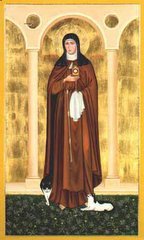 St Clare apparently loved cats, and had one special one who would sit on her bed as she knitted. Clare had trained her so that if the ball of yarn fell away, the cat would jump down and bring it back to her.
As in her life, St. Clare devoutly holds the monstrance with the Blessed Sacrament in protection of the monastery. At her feet are cats, symbolizing the contemplative life. Consistent with Franciscan love of nature, a sparrow nests in the colonnade, “Even the sparrow has found a home ... where she may have her young – a place near your altar, O Lord Almighty, my King and my God.” (Psalm 84:3)
I wonder if I’ll get used to God turning my mental and spiritual world upside down on a regular basis? So many unspoken – not to mention spoken – evangelical assumptions are getting exposed by the light of grace that I’m getting slightly vertiginous.
Sunlight early on cold stone
dry and rough
against our fingers;
the new fire flutters,
clinging to its twigs
in the wall angle,
against a chill breeze.
He is risen, and his light
finds our hearts in the still of dawn,
our bodies only half awake,
our white breath following us
to the porch and the great candle:
his light given,
that we must give and give.
the day taken out, like an empty hole in time, anechoic, no-thing.
Prayer is like this very often, a place without a place, “waterless over the harsh rocks, down the dry valley of heedless stones...”
What could have happened in the tomb, between Joseph and Nicodemus leaving, and that dawn of glory? There will never be a way to know: those hours were outside time, and what we are, creatures of days and years, cannot comprehend it.
Again prayer: the truer our prayer, the more we come to him who will forever be beyond our comprehension. We meet him as nearly face to face as we could ever bear, and yet we don’t recognise him. We don’t have the equipment to take him in – we are as uncomprehending as a profoundly deaf man at a symphony concert, or a blind cave salamander in a measureless cavern of crystal.
Tomorrow morning, Mary had this problem. She met her Lord and her Saviour face to face, and thought he was the gardener. Maria Boulding, from Marked for Life - Prayer in the Easter Christ:
Prayer is listening, listening to the word. Like Mary Magdalene we hear many words, but at rare intervals we hear the really piercing word, the word that affirms us in our beings, the fiat that creates and re-creates us. This word is our own name. It is the secret name written on the white stone that no one knows except him who receives it, the secret truth of our own person that we do not yet fully know ourselves but only glimpse, because it is only potentially true as yet, true to God but not yet fully brought to birth.
Tomorrow morning Jesus speaks our name, piercing our incomprehension with his recognition, his knowing, his comprehending us. Our part is to listen – listen into the anechoic disorienting silence, the dead room, the empty garden, long before dawn, “while it was still dark.” This is the time Mary set off, thinking she knew but not even knowing why she went, like we must go, not being able to know why till our Lord calls us by name, but going anyway, into the dark, into the place of tombs, the hortus conclusus, the garden closed to our senses but open to our going in. Listen... listen!
Darkness
and sun-shadows - the I AM
broken, thirsting forsaken.
The sun’s light failed
and the curtain tore
forever.
You, Jesus, agnus Dei,
qui tollis peccata mundi
accomplished this;
and wrecked despair
against the constant keep
of hope.
Holy Week seems like a good place to turn over a new blogging leaf, and Maundy Thursday particularly appropriate. Though we are many...
I’ve been well and truly convicted by reading Kathryn’s astonishing Good in Parts, as well as my long-time favourite Roman Catholic blogger and solitary Karen Marie Knapp. The Mercy Blog has been so impersonal, especially recently – and yet my life has been in such passionate turmoil over the period I’ve been posting here. I’ve been less than honest I guess, not speaking of the extraordinary journey God’s been taking me on over the last few months, and how he’s brought me back to the Anglican church after 7 years in the Baptist church, and the next 11 in the Vineyard. I’ll have to omit some of the finer details, as they involve other people, but suffice it to say it’s been quite a ride!
It’s crucially important too that for the last 3 years or so I’ve been involved in a conversation with various Franciscans, culminating in my being noviced as a Tertiary on March 4 this year. It just feels so right – Helen Julian CSF, in an essay published in New Daylight, calls it “finding a home.” And so it is. I’ve never been more sure of anything since marrying Jan!
As Mercy Site readers will know, the contemplative life has been drawing me in more and more deeply since, oh, 1978 at least, when I was introduced to the Jesus Prayer by Fr Francis Horner SSM, on an extended visit to Willen Priory. (He gave me Per Olof Sjögren’s wonderful book to read!) About that time, too, I began to read Thomas Merton, and he opened my eyes to the wonderful riches of the church’s experience in prayer. So wherever I’ve been, that’s been the centre of it all – the longing of God in my heart for closeness, intimacy; and the pain he’s let me feel for creation, for all my sister and brother creatures, human and otherwise – an ache that just doesn’t go away but gets stronger over the years and months, like St Paul says in Romans 8:19-23: “For the creation waits with eager longing for the revealing of the children of God; for the creation was subjected to futility, not of its own will but by the will of the one who subjected it, in hope that the creation itself will be set free from its bondage to decay and will obtain the freedom of the glory of the children of God. We know that the whole creation has been groaning in labour pains until now; and not only the creation, but we ourselves, who have the first fruits of the Spirit, groan inwardly while we wait for adoption, the redemption of our bodies.”
But the amazing thing that’s happened since I began to explore this possibility of returning to the Anglican church, is the joy of coming back to liturgical prayer. I’d been noticing for a few years that my own private “quiet times” had been taking on a more and more liturgical shape, all by themselves somehow, with psalms and readings and regular bits of Scripture that kept coming back, and which I guess I’d have to call canticles. Coming back to this kind of prayer among my sisters and brothers, especially in the context of the Eucharist, has been mind-blowing. I can only describe it as being like being carried along by a deep and powerful river, rather than splashing about trying to swim in the pools.
Some of my past colleagues might be saying to themselves here, “OK as far as it goes, maybe, but what about the Spirit? What about freedom in worship?” All I can say is that I’ve found the Holy Spirit to be alive and well and living in the Church, in every bit of it, in every denomination and movement and flavour. (Unless people really make a determined effort to shut him out, I suppose, but I have to admit I’ve yet to see this theoretical possibility in practice!) And he’s the same Spirit, yesterday and today and forever. I have found so much of grace, of love, of mercy – of Jesus – over recent months. No, I’m not missing out – I feel more like the woman in Luke 15, who lost her coin and found it again, “Rejoice with me!”

