Friday, May 23, 2008

Hidden...

I've been trying very hard this week to try to find a way to express this sense I have that so much of prayer goes on wordlessly, hidden even from the one praying. Trouble is, how does one write about something like that? I'm reminded of Lao Tzu's remark that "The Tao that can be told of is not the eternal Tao; the name that can be named is not the eternal name."

But the prayer does go on. I find that increasingly I cannot put God out of my mind. Whatever I try and think about, it's God and Jan, God and supper, God and music... Things somehow get tested against his presence, in the oddest way. Even decisions about technical things are not entirely exempt, like the ethics of open-source as opposed to commercially developed software!

More than that, I cannot get away from the pain that I feel, that Maggie Ross so tellingly describes as "the gnawing pain in the pit of your soul that is a resonance of the pain of the human condition..." (In my case, it's as often the pain of the rest of creation, the animals and the plants and the broken and hurting stuff of existence itself.) The only way to deal with such pain, against which I have less and less defence, is to pray. The Jesus Prayer comes more and more naturally, appearing at all sorts of times of the day or night, so that I'm not sure if I suddenly begin to pray, or whether I'm just suddenly aware that I have been praying all along...

Ironically, my set times of prayer have become more difficult: I am more easily distracted, more easily interrupted. I find myself constantly challenged, continually driven back to my rule like someone clinging to a floating spar in a tide race.

More and more I find myself enormously grateful for the Third Order, for the whole community of St. Francis throughout the world, in whichever denomination; religious and secular alike they are my sisters and brothers, the little ones of Jesus. I really don't know what I should do without them!

Wednesday, May 21, 2008

Becoming a Peacemaker...

What if God were to speak to us now; to give us a fresh look at what's real, true, and the core of our world? Might God say, "Be just, be kind, care, share, give, take, love, laugh, cry, feel the pain, and dance in the time of joy"? And what would we hear? Would it be what we want to hear, or what was said? Could we each hear in our own way? Must we all be of the same mind? Must the one who hears at twelve feet fight with the one who hears at twelve yards? Will the black one and the white one and the child of the land all know God in the same way? And if not, will they then fight?

What if God said, "I grant you a gift: a world full of peace, health, and food for all. I give you a time, now, when each may sit by his vine and by her fig tree and none will cause you fear"? Would we heed the words? If God came to each of us in a dream, would we hold the dream in our hearts and souls, or would we cast it off as just a dream? What would it take to look deep with in, where we live and know truth, and there to find the one God, who cries for us and waits and hopes and says, "I am here. Do not fear. Live, love, talk, and walk hand in hand with me. Let no child learn war anymore, but let each bring what is right and just in his home and in her land!"

Rabbi Albert M Lewis, Director of the Emeritus College at Aquinas, Grand Rapids, Michigan - courtesy of the Henri Nouwen Society
(Note: Rabbi Lewis has written this reflection using only one-syllable words. It is an old discipline, intended to be simple without being simplistic)

Monday, May 19, 2008

A long obedience in the opposite direction...

In a world of fugitives the person taking the opposite direction will appear to run away. If the truth has made us odd, if we have not accommodated ourselves out of all recognition, then it will appear to some people that we're running away, that we're living an escapist existence, that we're outsiders, even outlaws – whereas the truth is that we're the insiders, because we're bearing God's reality, not the world's. We are the true establishment, because we are building and inhabiting God's basilica, the commonwealth of eternity, not earth.

From: TS Eliot, The Family Reunion (hat-tip to inward/outward)

Sunday, May 18, 2008

Trinity Sunday

God For Us, we call You Father,
God Alongside Us, we call You Jesus,
God Within Us, we call You Holy Spirit.

You are the Eternal Mystery
That enables, enfolds, and enlivens all things,
Even us, and even me.

Every name falls short of your
Goodness and Greatness.
We can only see who You are in what is.
We ask for such perfect seeing.
As it was in the beginning, is now,
and ever shall be.
Amen.

Richard Rohr, from Simplicity

Saturday, May 17, 2008

Bearing pain into silence...

It's the night before Trinity Sunday, and I'm aware that I've been pretty silent this week, for which apologies. It's been a busy week, on the outside, but inside I've not been able to stop thinking about the passage from Maggie Ross I mentioned on Monday, where she says:

There are as many ways of intercession as there are moments of life. Intercession can become deep and habitual, hidden even from our selves. There is nothing exotic about such practice. What matters is the intention that creates the space and the stillness. Even something as simple as refusing to anesthetize the gnawing pain in the pit of your soul that is a resonance of the pain of the human condition is a form of habitual intercession. To bear this pain into the silence is to bring it into the open place of God’s infinite mercy. It is in our very wounds that we find the solitude and openness of our re-creation and our being. We learn to go to the heart of pain to find God’s new life, hope, possibility, and joy. This is the priestly task of our baptism.

This so accurately describes the path of prayer God has been leading me increasing along for nearly 30 years - acutely, for the last 10 years - that it is quite uncanny. It's also, by definition, hard to write about - hard even to think about, conceptually, since it is so hidden. As Maggie says, it is at times hidden even from ourselves.

Maggie writes of "the intention that creates the space and the stillness..." and it is this which the Jesus Prayer does. But it doesn't only do that: it helps us quite explicitly to "bear this pain into the silence... to bring it into the open place of God’s infinite mercy." The repetition of the words, "Lord Jesus Christ, Son of God, have mercy on me, a sinner" create a stillness and a crying, where the wounds of our openness to, our identification with, the pain of the human condition are lifted up to the Cross in all their particularity and is-ness, and in all our own defencelessness and conceptual defeat.

The astonishing thing is, it works - something happens, when we pray like this, far greater than our own little intellects can grasp. Or should I say, why should I be astonished that Jesus would answer this kind of prayer, so close to his own heart?*

There is far more to this way of praying than this, and I am only just beginning to understand a little of it. I shall hope to explore a little more here over the next week or so - but I hope you will bear with me if I am a bit faltering, both in regularity of posts and in my language - I find this difficult to write about, just as I know I must try...

    *Matthew 6.6; Luke 13.34; Luke 18.35ff; John 11.35 etc.

Monday, May 12, 2008

God's tears...

Another way to talk about intercession might be to say that because the life we have is a share in God’s life, when we pray on behalf of another, we are creating a space for God to use that life as is most appropriate, according to God’s light, not ours. Because of our shared nature with God, in this space our life becomes God’s life: God’s tears, God’s offering, God’s power. We set God free to work his mysterious love in ways that we should not care to seek to know, if we are rightly focused on God. Some people wake each night to devote a specific amount of time to this conscious offering of their lives on behalf of the world, to make a space, however humble, where some small fragment of human suffering can perhaps find a little respite and peace.

There are as many ways of intercession as there are moments of life. Intercession can become deep and habitual, hidden even from our selves. There is nothing exotic about such practice. What matters is the intention that creates the space and the stillness. Even something as simple as refusing to anesthetize the gnawing pain in the pit of your soul that is a resonance of the pain of the human condition is a form of habitual intercession. To bear this pain into the silence is to bring it into the open place of God’s infinite mercy. It is in our very wounds that we find the solitude and openness of our re-creation and our being. We learn to go to the heart of pain to find God’s new life, hope, possibility, and joy. This is the priestly task of our baptism.

From: Maggie Ross: The Space of Prayer, III

I do recommend reading Maggie's whole three-part (so far?) series on prayer - there are some profound and lovely things there, and a deep understanding of the contemplative way.

Pentecost a day late (I have an excuse...)

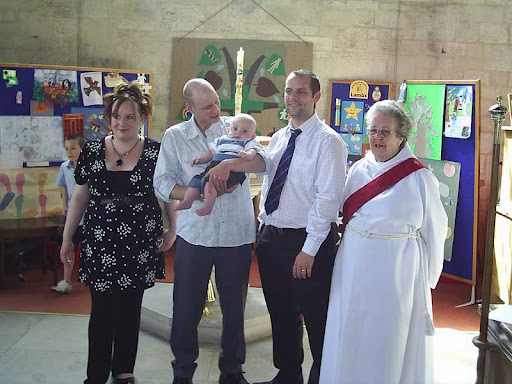
Little Tommy was baptised yesterday. What better day for it? The sun was shining over All Saints Church on Portland, and we remembered the day the Holy Spirit arrived in power...


Living in the Country...


You Should Live in the Country


You are laid back, calm, and good at entertaining yourself.

You don't need an expensive big city to keep you busy.

You'll take the peaceful life over the stressful life any day of the week.

Where Should You Live?


Seems I'm living in the right place, then.

Hat tip to Jane for this piece of perceptive silliness...

Friday, May 09, 2008

The Just One Book Meme

Thanks (?) to Diane, who gives the rules as:

Books are scarce in the world. They are illegal in some provinces. They are not easily replaced if not impossible to replace if lost in many if not most circumstances. If you can replace a book or buy one it is usually through the black market at astronomical costs that you cannot afford. Yet you have been able to maintain one of the best collections in the world. If your entire library was about to burn up (think of the firefighters in Fahrenheit 451 invading your home) and you could only have one* book to take with you other than the Bible, what would that be and why?

Simple Rules: Answer the question. Offer one quote that resonates with you. Tag five people whose response is of genuine interest to you and inform him or her that they have been tagged. Cheers!

*And it cannot be an entire series of something, that’s cheating.

Arrgh!

Has to be Julian of Norwich, in Sheila Upjohn's tremendous translation, All Shall Be Well. Can't be anyone else, really. Not even St. Francis, or St. Isaac of Nineveh, or Thomas Traherne, or Charles Williams, or Tolkien, or Philip Pullman, or Br. Ramon, or, or, or...

Enough!

But I'm not going to tag anyone, Diane. I never can. So if anyone reading this wishes to put themselves through this utterly miserable experience, be my guest. Just let me know whom I've haunted with this horrible thought, so I can offer appropriate penance...

Seven Spiritual Weapons...

Jesus Christ gave up his life that we might live, therefore, whoever wishes to carry the cross for his sake must take up the proper weapons for the contest, especially those mentioned here. First, diligence; second, distrust of self; third, confidence in God; fourth, remembrance of the Passion; fifth, mindfulness of one's own death; sixth, remembrance of God's glory; seventh, the injunctions of Sacred Scripture following the example of Jesus Christ in the desert.

St. Catharine of Bologna, On the Seven Spiritual Weapons

An obscure 15th Century Poor Clare puts her finger on so many of our troubles in following the way of prayer. Well, on mine, at least!

I'm aware that in the first decade of the 21st Century Sister Catharine's second weapon will sound a little strange to some, accustomed as we are to thoughts of self-realisation, self-actualisation, self-improvement, self-importance... but it is honestly essential. The older I get, and the longer I keep at this strange occupation of ours, the more it seems essential.

"The heart is deceitful above all things and beyond cure. Who can understand it?" (Jeremiah 17.9 NIV)

The heart deceives itself; it deceives the very person in whose breast it beats. Unless we trust God utterly, and ourselves very little, we're going to trip over every spiritual obstacle, and every quirk of our own humanness - what used to be called "the flesh".

There's nothing perverse or sinister in what Catharine is saying. It's only when we don't take her advice that we have recourse to hair shirts and cold baths. So long as we walk in the way of the Psalmist who said, "I have strayed like a lost sheep. Seek your servant, for I have not forgotten your commands." (Psalm 119.176 NIV) we'll be OK. God's word will light our path, and all our prayers will be from the heart of a God we can trust utterly, who holds our trembling helplessness gently in his pierced hands, and loves us no matter what.

Thursday, May 08, 2008

The Prayer of the Heart

I think Sister Julian would have approved of the following!

It is difficult to speak of the aim or goal of [contemplative] prayer, for there is a sense in which it is a process of union which is as infinite as it is intimate... The meaning and design of the Jesus Prayer is an ever deepening union with God, within the communion of saints. It is personal, corporate and eternal, and the great mystics, in the Biblical tradition, come to an end of words. They say that "eye has not seen nor ear heard", they speak of "joy unspeakable" and "groanings unutterable" and "peace that passes understanding".

But there are some things which we can say, which are derivative of that central core of ineffable experience. We can say that such prayer contains within itself a new theology of intercession. It is not that we are continually naming names before God, and repeating stories of pain, suffering and bereavement on an individual and corporate level, but rather that we are able to carry the sorrows and pains of the world with us into such contemplative prayer as opens before us in the use of the Jesus Prayer. God knows, loves and understands more than we do, and he carries us into the dimension of contemplative prayer and love, and effects salvation, reconciliation and healing in his own way, using us as the instruments of his peace, pity and compassion.

Thus we can say that the "prayer of the heart" unites us with the whole order of creation, and imparts to us a cosmic awareness of the glory of God in both the beauty and the sadness of the world. The process of transfiguration for the whole world has begun in the Gospel, but it will not be completed until the coming of Christ in glory. And until that time we are invited, through prayer, to participate in the healing of the world's ills by the love of God. And if we participate at such a level, then we shall know both pain and glory. The life and ministry of Jesus in the gospels reveal this dimension, for Jesus was at one and the same time the "man of sorrows, acquainted with grief", and the transfigured healer, manifesting the glory of the Father upon the holy mountain.

Brother Ramon SSF Praying the Jesus Prayer Marshall Pickering 1988

Julian of Norwich, contemplative, mystic, counsellor, theologian

Wonderful and glorious is the place where the Lord lives. And so it is his will that we turn quickly at his gracious touch, rejoicing more in his entire love that sorrowing over our frequent falling.

For it is the greatest worship we can give him, that we should live gladly and merrily because of his love while we are here in penance. For he looks on us so tenderly that he sees all our living as penance. For the natural longing we have for him is an everlasting penance to us - and he mercifully helps us bear it.

For his love makes him long for us, and his wisdom and truth, with his rightfulness, make him allow us to be here. And he wills that we see it like this.

For this penance is natural to us, and is the highest - as I see it. For this penance never leaves us until the time we are fulfilled and have him as our reward.

Julian of Norwich, Showings (Long Text) Chapter 81 Tr. Sheila Upjohn

Wednesday, May 07, 2008

The Praises of God

Lord God:
you alone are holy,
you who work wonders!
You are strong, you are great,
you are the Most High,
you are the almighty King,
you, holy Father, King of heaven and earth.

Lord God: you are Three and you are One,
you are goodness, all goodness,
you are the highest Good,
Lord God, living and true.

You are love and charity, you are wisdom,
you are humility, you are patience,
you are beauty, you are sweetness,
you are safety, you are rest, you are joy,
you are our hope
and our delight,
you are justice, you are moderation
you are all our wealth
and riches overflowing.

You are beauty, you are gentleness,
you are our shelter, our guard
and our defender,
you are strength, you are refreshment,
you are our hope.
you are our faith.
you are our love,
you are our complete consolation,
you are our life everlasting,
great and wonderful Lord,
all powerful God, merciful Saviour!

Amen.

St. Francis of Assisi

Monday, May 05, 2008

The time between...

We are between Ascension Day and Pentecost: we are in the Novena: in the nine days between. This is the original meaning of the term. These between times in the Christian year always seem like thin places to me, times when whatever it is divides the material and the spiritual, this world and the next, is somehow less dense, permeable almost.

In these nine days - between our Lord's ascension to the Father, and the outpouring of the promised Holy Spirit - his mother Mary, together with "certain women" (I think we can guess who was among them!), his brothers, and the Apostles, "were constantly devoting themselves to prayer." (Acts 1.13-14) It must have been strange for them. They had no real idea how long they were going to have to wait, nor quite what it was they were waiting for. They just knew Jesus had told them to wait. Oh, he had told them to wait to "be baptised with the Holy Spirit" - but they had no real frame of reference for that.

We are ourselves living in the times between. We live between birth, which we can't really remember, and death, which we can't really imagine. We know, as Christians, that death isn't the end of the story; but what lies on the other side of death we can't imagine either. More than this: we lives in the times between our Lord's ministry on earth, his crucifixion, resurrection and ascension, and his Parousia, his "coming again" - whatever that means. On the far side of Parousia lies the Eschaton, and at that our imaginations finally, and completely, fail. Well, mine does. If what John the Evangelist was shown was in fact a glimpse of it, even his philosophical mind and his wonderful grasp of Greek failed him, and we are left with the enigma (I almost said mare's nest) that we call The Revelation.

So what did the original followers of Jesus do, lost like us in their time between, not knowing how long they were waiting, or for what, really? They constantly devoted themselves to prayer. I can't myself think of any other possible reaction... I suppose that is why I find myself so strongly, so deeply called to the life of prayer. I am confused, puzzled. I find this whole thing of being between Parousia and Eschaton, between birth and death, between the chthonic and the spiritual, just baffling, just as I find it baffling (Romans 8.26) to know how to pray. And that, as much as anything, is why I seem to have been called to pray the Jesus Prayer. "Lord Jesus Christ, Son of God, have mercy on me, a sinner." What else is there to say?


Saturday, May 03, 2008

The paradox of freedom...

It's quite clear that in the final analysis it's the grace of Christ that liberates us. It's the experience of unconditional love that really sets us free.

But first we have to be led to the circumstances that make it possible for this love to get through to us, so that we can sense and experience the need for this new life.

Richard Rohr, from Simplicity


This is what so often seems so scary about the Christian life. TS Eliot once called it, "A condition of complete simplicity / (Costing not less than everything)" (Little Gidding, from Four Quartets), and Jesus himself spoke of taking up one's cross in order to follow him. But it is true.

Jesus gives us a hint, perhaps. To the Jews who had believed him, he said, "If you hold to my teaching, you are really my disciples. Then you will know the truth, and the truth will set you free." (John 8.31-32 NIV)

Love, truth, freedom. And yet they can only be found through obedience. As always, paradox, resolved in grace, in mercy.

Psalm 119 sums it up:

Before I was afflicted I went astray,
but now I obey your word...

It was good for me to be afflicted
so that I might learn your decrees...

I know, O LORD, that your laws are righteous,
and in faithfulness you have afflicted me.

May your unfailing love be my comfort,
according to your promise to your servant.

Let your compassion come to me that I may live,
for your law is my delight.

(Ps 199.67,71,75-77 NIV)

That's all?

I love this little essay from among Barbara Crafton's Almost Daily eMos. She captures the essence of contemplation more clearly, for me, in these few simple sentences than many more scholarly attempts:

The church in the morning is dark. The candles offer a more encouraging beauty than electric lights ever could, and so we leave them off in the sanctuary. Something about lighted candles in a church quiets the mind and stills the tongue, and the day begins with a certain hush, a quiet easing into the world.
In the evening, the sun lights the window in the sanctuary, firing all its colors and bringing them to life. It is so brilliant that you could leave the candles unlit and nobody would notice. But we light them anyway. Lighting a candle to begin a set-aside time for quiet contemplation, scripture and prayer is a signal. Do it often enough, and the very lighting of the candle triggers prayer itself. The human capacity to condition ourselves, to form habits of spiritual response to physical things, is a powerful aid to the spiritual life.

These contemplative moments are times when one understands that understanding is not the sole goal of the spiritual life. Human reason is a gift, but it is not our only gift. That quiet, receptive waiting that begins when we go to the prayer place at the prayer time, light the prayer candle, pick up the prayer book, inhale deeply the old-hymnals-fresh-candlewax-memory-of-furniture-polish smell of a place that 140 years of prayer have made holy: that receptive waiting is a gift, too. Just as we exercise our minds by learning, we exercise our capacity to receive simply by showing up in the prayer place and waiting, content to be empty until God fills us.

And then what happens, when God fills us? Might we fall to the ground, burst into ecstatic utterance? Well, we might. Mostly, though, we will just close our books when we are finished and thank each other for sharing this prayer. Then we go home, or go to work, or go make supper. Quiet. Calm. Ready for what comes. Over and over again, the same dependable readiness to meet the day or sleep the night can be mine or yours or anybody's. Just by showing up.

That's all? Shouldn't it be harder? Isn't more demanded of us? Oh, much is demanded of us in life, but it is not demanded here. Here, in the prayer place, we are not the ones who give. We are the ones who receive.

Pope Benedict XVI - no Dr Strangelove...

Do go and read this excellent (London) Times Online commentary from Gerard Baker - yet another whom the new Pope has thoroughly won over! (The title of this post is the title of Mr Baker's article.)

Here's a snippet:

...the Pope’s most compelling words are a constant reminder of how absurd his
stereotype has been. He speaks repeatedly of the simple beauty of human
love.


Shortly before he became Pope, Benedict told a congregation: “Christianity is
not an intellectual system, a collection of dogmas, or a moralism.
Christianity is instead an encounter, a love story, an event.”


This idea of faith as a love story — God’s love for his people, and our love
for Christ, the human face of God — is what Benedict seems to want us to
understand as the defining theme of his papacy. His first encyclical was not
on birth control or gay marriage, but on what many considered the somewhat
surprising subject of the simple divinity of human love, including the
sanctity of erotic love. This emphasis on the centrality of love to the
human condition is so at odds with the caricature of the doctrinal
vigilante, endlessly lecturing on the perils of sexual intemperance, that it
requires us to think hard about the very nature of religion’s role in modern
life. It is a useful counterweight to the popular secular view that religion
is the root of all human discord...


Friday, May 02, 2008

Friday Cat Blogging - the cat next door

This is Griffin, the cat next door, relaxing on our patio... which is I fear overdue for a spring clean!


Calvinism?

Sue, over at Discombobula, links to this wonderful article by Dr. C. Baxter Kruger, on Calvinism and why he left! Superb reading - I'd advise clicking over and reading the whole thing - but here's a little snippet to whet your appetite:

The apostles are crystal clear that it was in and through and by and for Jesus that all things came into being and are sustained. Let me cite a few verses.

In the beginning was the Word, and the Word was with God, and the Word was God. He was in the beginning with God. All things came into being by Him, and apart from Him nothing came into being that has come into being (John 1:1-3).

For by Him all things were created, both in the heavens and on earth, visible and invisible, whether thrones or dominions or rulers or authorities—all things have been created by Him and for Him. And He is before all things, and in Him all things hold together (Colossians 1:16-17).

And He is the radiance of His glory and the exact representation of His nature, and upholds all things by the word of His power (Hebrews 1:3).


John and Paul and the author of Hebrews are emphatic that Jesus is the Creator and that not one thing that was created came into being in any way other than through Jesus Christ. And note that this point is not relegated to obscure footnotes in the latter chapters of their writings. This is the first point. As a side note, when is the last time you heard a sermon on the fact that Jesus is the Creator, the one in and through and by and for whom all things were created? Why isn’t such an obvious apostolic emphasis prominent in our preaching today?

My point here is to say that in the apostolic mind there is a definite and clear connection between Jesus Christ and all creation. Unless we are prepared to posit that the Father created and sustains creation’s existence behind the back of his Son, then, with the apostles, we affirm that everything came into being through the Father’s Son, and we affirm that everything continues to live and move and have its being through him (see Acts 17:28 and I Corinthians 8:6-7). Everything, including every human being, derives existence through Christ and breathes Christological air.

I shan't even try to summarise Dr Kruger's actual argument here; suffice it to say, he underlines my every misgiving about Calvinism as theology, while retaining respect and affection for the great John Calivin himself.

Thursday, May 01, 2008

Ascension Day!

Blessed are you, almighty God,
through Jesus Christ the King of glory.
Born of a woman,
he came to our rescue.
Dying for us,
he trampled death and conquered sin.
By the glory of his resurrection
he opened the way to life eternal
and by his ascension,
gave us the sure hope
that where he is we may also be.
For these and all your mercies, we praise you,
Father, Son and Holy Spirit:
Blessed be God for ever!

(Oremus for Thursday, May 1, 2008
The Ascension of Our Lord Jesus Christ)
(opening prayer)