
I did promise to post a picture of Figgy, the contemplative cat. This is she, in typical pose! (I hate to admit it, but that's my desk in typical pose as well...)

There are crimes which no one would commit as an individual which he willingly and bravely commits when acting in the name of his society, because he has been (too easily) convinced that evil is entirely different when it is done ‘for the common good.’ As an example, one might point to the way in which racial hatreds and even persecution are admitted by people who consider themselves, and perhaps in some sense are, kind, tolerant, civilized and even humane. But they have acquired a special deformity of conscience as a result of their identification with their group, their immersion in their particular society. This deformation is the price they pay to forget and to exorcise that solitude which seems to them to be a demon.
From Disputed Questions by Thomas Merton
(Harcourt Brace Jovanovich, Publishers, New York, 1960) Page 183.
Half a century ago words like ‘gay’, ‘ecstasy’ and ‘wicked’ meant something very different than they do today. In the past ‘evangelical’ stood for four key values:
a commitment to the authority and centrality of scripture,
a call to personal faith and repentance,
the centrality of Christ’s death as our substitute,
putting faith into action through evangelism and social action.
Now to the unchurched and people of other faiths – evangelical is increasingly shorthand for: right-wing US politics, an arrogant loud mouth who refuses to listen to other people’s opinions, men in grey suits who attempt to crowbar authorised version scripture verses into every situation, or ‘happy-clappy’ simpletons who gullibly swallow whatever their tub thumping minister tells them to believe. Large parts of the British media seem happy to paint evangelicals into that stereotype. Today in the UK ‘evangelical’ is often linked with the ultimate 21st century swearword ‘fundamentalist’. The result is the name ‘evangelical’ which years ago, may have smelt of roses – now has the aroma of the manure that fertilises the bush.
This has connections with my ‘Upside Down’ post, only what I was suggesting was more than a play on words. I fear that our actual thought processes, our ways of relating to God and to our neighbour, our capacity to love, to minister grace, to embody Christ in his mercy and his purity, are being eroded by what is happening as right-wing attitudes and fundamentalist hermeneutics infiltrate the evangelical church. (Think of George Orwell’s definition of doublethink!)
I am deeply disturbed by all this.
I was reading someone’s summary of their own character in a blog profile somewhere the other day, and it set me thinking. Am I a romantic?
Now, if romantic implies expensive boxes of chocolate, small bunches of dewy red roses, tuxedos and patent-leather dancing shoes for men, and floaty dresses and stiletto heels for women, then I’m not, not, not a romantic. No way.
If on the other hand it implies long walks on the beach at sunset, going to sleep in one another’s arms, giving one’s heart and one’s commitment and one’s total intimacy to one other person, then I am definitely a romantic.
Am I an evangelical?
Now, if this implies uncritical acceptance of the industrial west, our foreign policy and our policies on economics, immigration, social welfare, housing; if it implies reading the Bible as one might read a manual for a washing machine, applying literally both Old Testament laws and every paragraph of all Paul’s letters to our own ways of doing church; if it implies a way of life lived according to instructions from church leadership that can’t be questioned in case one is thought disobedient or lacking in accountability; if it means in practice (no matter what may be said in theory) preferring law to grace, rules to love, doctrinal and ethical purity to mercy and acceptance, then I’m so not an evangelical.
If on the other hand it implies treating the Bible as God’s inspired word to his creation; if it implies taking seriously the Good News of Jesus, in all its grace and mercy, all its power and radically demanding purity, then maybe I am.
If I’m not an evangelical, then am I a liberal?
Well if that implies treating the Bible as no more than another set of axiomatically questionable ancient texts to be demythologised; if it implies treating the Good News of Jesus as just another set of ethical ramblings by a long-dead wise man; if it implies treating theology as just another academic discipline properly confined within the corridors of universities, and prayer as one of many techniques of self-hypnosis, then no, no chance.
But if it implies understanding the Bible as God’s word given to imperfect, culturally conditioned human beings, and expressed not only in history, theology and moral instruction, but also in poetry, polemic and narrative; if it implies recognising that while Paul wrote some of the most penetrating and profound theology, and some of the most poignant personal meditations on God and life, some of his letters contain very limited, particular advice to individual local churches that are not only very different from each other but immensely different culturally from anything we might encounter, especially in the west; if it implies “freedom to develop unique ways of approaching God and talking about Christianity”, and freedom from “dogmatic statements and claims of absolute truth on finer doctrinal points” (quotes from Wikipedia), then maybe I am.
Not for the first time, I’m so grateful simply to be able to call myself a Franciscan!
[Sorry about all the 'I's - you can read 'one' if you prefer, but personally one feels uncomfortable writing as though one were a member of the Royal Family...]
They had seen strange enough things at the Doorway. But it was stranger than any of them to look round and find themselves in warm daylight, the blue sky above them, flowers at their feet and laughter in Aslan’s eyes. He turned swiftly round, crouched lower, lashed himself with his tail and shot away like a golden arrow.
“Come further in! Come further up!” he shouted over his shoulder. But who could keep up with him at that pace?
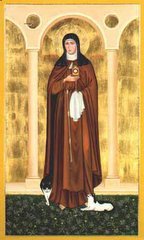 St Clare apparently loved cats, and had one special one who would sit on her bed as she knitted. Clare had trained her so that if the ball of yarn fell away, the cat would jump down and bring it back to her.
As in her life, St. Clare devoutly holds the monstrance with the Blessed Sacrament in protection of the monastery. At her feet are cats, symbolizing the contemplative life. Consistent with Franciscan love of nature, a sparrow nests in the colonnade, “Even the sparrow has found a home ... where she may have her young – a place near your altar, O Lord Almighty, my King and my God.” (Psalm 84:3)
I wonder if I’ll get used to God turning my mental and spiritual world upside down on a regular basis? So many unspoken – not to mention spoken – evangelical assumptions are getting exposed by the light of grace that I’m getting slightly vertiginous.
Sunlight early on cold stone
dry and rough
against our fingers;
the new fire flutters,
clinging to its twigs
in the wall angle,
against a chill breeze.
He is risen, and his light
finds our hearts in the still of dawn,
our bodies only half awake,
our white breath following us
to the porch and the great candle:
his light given,
that we must give and give.
the day taken out, like an empty hole in time, anechoic, no-thing.
Prayer is like this very often, a place without a place, “waterless over the harsh rocks, down the dry valley of heedless stones...”
What could have happened in the tomb, between Joseph and Nicodemus leaving, and that dawn of glory? There will never be a way to know: those hours were outside time, and what we are, creatures of days and years, cannot comprehend it.
Again prayer: the truer our prayer, the more we come to him who will forever be beyond our comprehension. We meet him as nearly face to face as we could ever bear, and yet we don’t recognise him. We don’t have the equipment to take him in – we are as uncomprehending as a profoundly deaf man at a symphony concert, or a blind cave salamander in a measureless cavern of crystal.
Tomorrow morning, Mary had this problem. She met her Lord and her Saviour face to face, and thought he was the gardener. Maria Boulding, from Marked for Life - Prayer in the Easter Christ:
Prayer is listening, listening to the word. Like Mary Magdalene we hear many words, but at rare intervals we hear the really piercing word, the word that affirms us in our beings, the fiat that creates and re-creates us. This word is our own name. It is the secret name written on the white stone that no one knows except him who receives it, the secret truth of our own person that we do not yet fully know ourselves but only glimpse, because it is only potentially true as yet, true to God but not yet fully brought to birth.
Tomorrow morning Jesus speaks our name, piercing our incomprehension with his recognition, his knowing, his comprehending us. Our part is to listen – listen into the anechoic disorienting silence, the dead room, the empty garden, long before dawn, “while it was still dark.” This is the time Mary set off, thinking she knew but not even knowing why she went, like we must go, not being able to know why till our Lord calls us by name, but going anyway, into the dark, into the place of tombs, the hortus conclusus, the garden closed to our senses but open to our going in. Listen... listen!
Darkness
and sun-shadows - the I AM
broken, thirsting forsaken.
The sun’s light failed
and the curtain tore
forever.
You, Jesus, agnus Dei,
qui tollis peccata mundi
accomplished this;
and wrecked despair
against the constant keep
of hope.
Holy Week seems like a good place to turn over a new blogging leaf, and Maundy Thursday particularly appropriate. Though we are many...
I’ve been well and truly convicted by reading Kathryn’s astonishing Good in Parts, as well as my long-time favourite Roman Catholic blogger and solitary Karen Marie Knapp. The Mercy Blog has been so impersonal, especially recently – and yet my life has been in such passionate turmoil over the period I’ve been posting here. I’ve been less than honest I guess, not speaking of the extraordinary journey God’s been taking me on over the last few months, and how he’s brought me back to the Anglican church after 7 years in the Baptist church, and the next 11 in the Vineyard. I’ll have to omit some of the finer details, as they involve other people, but suffice it to say it’s been quite a ride!
It’s crucially important too that for the last 3 years or so I’ve been involved in a conversation with various Franciscans, culminating in my being noviced as a Tertiary on March 4 this year. It just feels so right – Helen Julian CSF, in an essay published in New Daylight, calls it “finding a home.” And so it is. I’ve never been more sure of anything since marrying Jan!
As Mercy Site readers will know, the contemplative life has been drawing me in more and more deeply since, oh, 1978 at least, when I was introduced to the Jesus Prayer by Fr Francis Horner SSM, on an extended visit to Willen Priory. (He gave me Per Olof Sjögren’s wonderful book to read!) About that time, too, I began to read Thomas Merton, and he opened my eyes to the wonderful riches of the church’s experience in prayer. So wherever I’ve been, that’s been the centre of it all – the longing of God in my heart for closeness, intimacy; and the pain he’s let me feel for creation, for all my sister and brother creatures, human and otherwise – an ache that just doesn’t go away but gets stronger over the years and months, like St Paul says in Romans 8:19-23: “For the creation waits with eager longing for the revealing of the children of God; for the creation was subjected to futility, not of its own will but by the will of the one who subjected it, in hope that the creation itself will be set free from its bondage to decay and will obtain the freedom of the glory of the children of God. We know that the whole creation has been groaning in labour pains until now; and not only the creation, but we ourselves, who have the first fruits of the Spirit, groan inwardly while we wait for adoption, the redemption of our bodies.”
But the amazing thing that’s happened since I began to explore this possibility of returning to the Anglican church, is the joy of coming back to liturgical prayer. I’d been noticing for a few years that my own private “quiet times” had been taking on a more and more liturgical shape, all by themselves somehow, with psalms and readings and regular bits of Scripture that kept coming back, and which I guess I’d have to call canticles. Coming back to this kind of prayer among my sisters and brothers, especially in the context of the Eucharist, has been mind-blowing. I can only describe it as being like being carried along by a deep and powerful river, rather than splashing about trying to swim in the pools.
Some of my past colleagues might be saying to themselves here, “OK as far as it goes, maybe, but what about the Spirit? What about freedom in worship?” All I can say is that I’ve found the Holy Spirit to be alive and well and living in the Church, in every bit of it, in every denomination and movement and flavour. (Unless people really make a determined effort to shut him out, I suppose, but I have to admit I’ve yet to see this theoretical possibility in practice!) And he’s the same Spirit, yesterday and today and forever. I have found so much of grace, of love, of mercy – of Jesus – over recent months. No, I’m not missing out – I feel more like the woman in Luke 15, who lost her coin and found it again, “Rejoice with me!”
© Copyright 2005 Shalem Institute. All rights reserved.
In technological society, in which the means of communication and signification have become fabulously versatile, and are at the point of an even more prolific development, thanks to the computer with its inexhaustible memory and its capacity for immediate absorption and organization of facts, the very nature and use of communication itself becomes unconsciously symbolic. Though he now has the capacity to communicate anything, anywhere, instantly, man finds himself with nothing to say. Not that there are not many things he could communicate, or should attempt to communicate. He should, for instance, be able to meet with his fellow man and discuss ways of building a peaceful world. He is incapable of this kind of confrontation. Instead of this, he has intercontinental ballistic missiles which can deliver nuclear death to tens of millions of people in a few moments. This is the most sophisticated message modern man has, apparently, to convey to his fellow man. It is, of course, a message about himself, his alienation from himself, and his inability to come to terms with life.
From Love and Living by Thomas Merton, edited by Naomi Burton Stone and Br. Patrick Hart (San Diego, New York, London: Harcourt Brace Jovanovich, 1985) Page 64-65.
From Love and Living by Thomas Merton, edited by Naomi Burton Stone and Br. Patrick Hart (San Diego, New York, London: Harcourt Brace Jovanovich, 1985) Page 120.
[Courtesy of the Thomas Merton Foundation]
"We have seen that the Jesus Prayer involves body, mind and spirit... The cosmic nature of the Prayer means that the believer lives as a human being in solidarity with all other human beings, and with the animal creation, together with the whole created order (the cosmos). All this is drawn into and affected by the Prayer. One person's prayers send out vibrations and reverberations that increase the power of the divine Love in the cosmos.
The Christian is well aware of the fact that the world is also evil. There is a falseness and alienation which has distracted and infected the world, and men and women of prayer, by the power of the Name of Jesus, stand against the cosmic darkness, and enter into conflict with dark powers... The power of the Jesus Prayer is the armour against the wiles of the devil, taking heed of the apostle's word, 'Pray at all times in the Spirit, with all prayers and supplications...' [Ephesians 6:18]"
From Praying the Jesus Prayer by Br Ramon SSF (Basingstoke: Marshall Pickering, 1988) Page 26.
From New Seeds of Contemplation by Thomas Merton
(New York: New Directions Publishing Company, 1961) Page 12.

