Tuesday, September 25, 2012

Faithful at any cost?

Many people live with the unconscious or conscious expectation that eventually things will get better; wars, hunger, poverty, oppression, and exploitation will vanish; and all people will live in harmony.  Their lives and work are motivated by that expectation.  When this does not happen in their lifetimes, they are often disillusioned and experience themselves as failures.

But Jesus doesn't support such an optimistic outlook.  He foresees not only the destruction of his beloved city Jerusalem but also a world full of cruelty, violence, and conflict.  For Jesus there is no happy ending in this world.  The challenge of Jesus is not to solve all the world's problems before the end of time but to remain faithful at any cost.

Henri Nouwen - with thanks to the Henri Nouwen Society

Faithfulness; trust; mercy. It seems to me that these three are inextricably linked. God's mercy, Christ himself, is faithful beyond our imagining, and it is only in him that our own little faithfulness can subsist at all. We trust so little.

Irma Zaleski says, "It is our failure of trust, our turning away from God and focusing on ourselves - our self-centredness - our need to protect ourselves at all cost, which the Fathers considered the root of all sin. Because we are unable to anybody or anything, and, above all else, because we are unable to trust God, we are compelled to reply on our own resources, to attempt to find our own happiness, and to fulfil our own desires and needs. We are imprisoned, stranded on the island of our self. We are all exiles from Paradise."

The only way out is repentance: trusting God in Christ enough to give up struggling, give up our self-reliance, and to cry out unceasingly, like some 21st-century Bartimaeus, for mercy, in whatever words, or wordlessness, we are given...

Sunday, September 16, 2012

The Name of Jesus

36. The use of the Holy Name not only brings anew the knowledge of our own union with Jesus in His incarnation. The Name is also an instrument by which we may obtain a wider view of Our Lord's relation to all that God has made. The Name of Jesus helps us to transfigure the world into Christ (without any pantheistic confusion). Here is another aspect of the invocation of the Name: it is a method of transfiguration.

37. It is so in regard to nature. the natural universe may be considered the handwork of the Creator... It can be considered as the visible symbol of the invisible divine beauty... And yet all this is insufficient. Creation is not static. It moves, striving and groaning, towards Christ as its fulfilment and end. (Romans 8.21,22) What we call the inanimate world is carried along by a Christward movement. All things were converging towards the Incarnation. The natural elements and the products of the earth, rock and wood, water and oil, corn and wine, were to acquire a new meaning and to become signs and means of grace. All creation mysteriously utters the Name of Jesus: 'I tell you that, if these should hold their peace, the stones would immediately cry out.' (Luke 19.40) It is the utterance of his Name that Christians should hear in nature. By pronouncing the Name of Jesus upon natural things, upon a stone or a tree, a fruit or a flower, the sea or a landscape, or whatever it is, the believer speaks aloud to the secret of these things, he brings them to their fulfilment, he give an answer to their long and apparently dumb waiting... We shall say the Name of Jesus in union with all creation...

38. The animal world may also be transfigured by us. When Jesus remained forty days in the wilderness, he 'was with the wild beasts.' (Mark 1.13) We do no know what happened then, but we may be assured that no living creature is lift untouched by Jesus' influence. Jesus himself said of the sparrows that 'not one of them is forgotten before God.' (Luke 12.6) We are like Adam when he had to give a name to all the animals... Scientists call them as they think fit. As to us, if we invoke the Name of Jesus upon the animals, we give them back their primitive dignity which we so easily forget--the dignity of living beings being created and cared for by God in Jesus and for Jesus...

On the Invocation of the Name of Jesus, Lev Gillet (A Monk of the Orthodox Church)
Fellowship of St. Alban and St. Sergius, 1949

This is one of the most extraordinary and profound passages on prayer that I have read. (The 'Invocation of the Name of Jesus' referred to is, of course, the Jesus Prayer, as the book explains elsewhere.) All that is necessary in prayer is to bring those we hold in our hearts, in our perception even, into the presence of Christ by this prayer of the Name.

Yet Gillet's theology of the Prayer is more radical even than this. (It is small wonder this little book is not better known nor more widely available!) Earlier he writes:

27. The Name of Jesus brings us more than his presence. Jesus is present in the Name as a Saviour, for the word 'Jesus' means just this: saviour or salvation... Jesus began his earthly mission by healing and forgiving...

28. The Name of Jesus not only helps us to obtain the fulfilment of our needs... (John 16.23-24) But the Name of Jesus already supplies our needs. When we require the succour of Our Lord we should pronounce his Name in faith and hope, believing that we already receive what we ask for. Jesus Himself is the supreme satisfaction of all men's needs. And He is that now, as we pray. Let us not regard our prayer in relation to fulfilment in the future, but in relation to fulfilment in Jesus now. He is more than the giver of what we and others need. He is also the gift. He is both giver and gift, containing in Himself all good things... This is quite another thing than if he had merely given them to us. Now we may find in his Name all that he is. Therefore the Name of Jesus, in so far as it links us with Jesus Himself, is already a mystery of salvation...

(ibid.)

When I discovered this little pamphlet (it is only 32 pages long) on the bookshelf in one of the guest houses at Hilfield Friary, it was like discovering that someone had put words to my own deepest intuitions and longings. It struck me speechless for a long time, and I am only just beginning to try and think through some of the implications, at least for my own life of prayer. I'll try to write more here shortly.

Sunday, August 26, 2012

Fasting of the heart…

Fasting of the heart means hearing, but not with the ear... The hearing that is only in the ears is one thing. The hearing of the understanding is another. But the hearing of the spirit is not limited to any one faculty, to the ear, or to the mind. Hence it demands the emptiness of all the faculties. And when the faculties are empty, then the whole being listens. There is then a direct grasp of what is right there before you that can never be heard with the ear or understood with the mind. Fasting of the heart empties the faculties, frees you from limitation and from preoccupations. Fasting of the heart begets unity and freedom... If you can do this, you will be able to go among men in their world without upsetting them. You will not enter into conflict with their ideal image of themselves...

Look at this window. It is nothing but a hole in the wall, but because of it the whole room is full of light. So when the faculties are empty, the heart is full of light. Being full of light, it becomes an influence, by which others are secretly transformed.

The Way of Chuang Tzu Thomas Merton, with thanks to Diane Walker

Fasting of the heart… I have hesitated to post here, because I haven’t had the words for what has been happening within by own heart. Perhaps a kind of fasting is the best way to describe it. So much that we mistake for certainty is in fact preconception, and we cling to our preconceptions as to lifebelts in the great wash of God’s presence.

We do not realise the vastness of God – at least, I don’t – the sheer appalling otherness of this istigkeit we presume to worship.

Aslan is no tame lion, as CS Lewis reminded us. Our Lord’s incarnation is often said to dissolve the distances between God and man, but what kind of a man was it his disciples, the women and men who walked and ate and drank with him day in and day out, actually knew? He terrified them on occasion (Matthew 14:22-33), struck them witless with awe (Luke 9:23-33), baffled them (John 6.43-68), and, after his resurrection, was at times simply unrecognisable (Luke 24.15-16; John 20.14-15).

“…what are human beings that you are mindful of them, mortals that you care for them?” as the Psalmist (8.4) says. A presence so great that he encompasses the galaxies, the vast interstellar chasms, and yet knows and cares for the fall of a sparrow… What can we know of such a presence, except what we are shown by him?

Tiny and broken, what can we cry but, Lord Jesus Christ, Son of God, have mercy on me, a sinner?

Monday, August 13, 2012

The George Smileys of the spiritual life…

Hiddenness is an essential quality of the spiritual life. Solitude, silence, ordinary tasks, being with people without great agendas, sleeping, eating, working, playing ... all of that without being different from others, that is the life that Jesus lived and the life he asks us to live.  It is in hiddenness that we, like Jesus, can increase “in wisdom, in stature, and in favour with God and with people” (Luke 2.51).  It is in hiddenness that we can find a true intimacy with God and a true love for people.

Even during his active ministry, Jesus continued to return to hidden places to be alone with God.  If we don't have a hidden life with God, our public life for God cannot bear fruit.

Henri Nouwen, from Bread for the Journey

It’s tempting to think of hiddenness as more dramatic than it is: heroic journeys to the depths of the wilderness, hermits whose very doors have been bricked up. And yet that isn’t really hiddenness—extreme eremitism brings its own fame.

Hiddenness, especially in today’s society, is much more likely to consist in being plain and unremarkable, George Smileys of the spiritual life…

I don’t find this easy. I’m as drawn as the next person to getting up to things that may show me in a favourable light, to getting involved with visible stuff to a point where I can no longer remain hidden. A lot of these things are good and useful in themselves, and yet they don’t seem to help with the life of prayer at all. I’ve explored these things before in this blog, yet I don’t seem any closer to an answer. Meanwhile, I still long to live like ivy, constant in the shadowed places…

Saturday, August 11, 2012

A blessing of St Clare of Assisi

In the name of the Father and of the Son and of the Holy Spirit. May the Lord bless you and keep you. May he show his face to you and be merciful to you. May he turn his countenance to you, my sisters, and daughters, and give peace to you, and to all the others who come and remain in your company as well as to others now and in the future, who have persevered in every other monastery of the Poor Ladies.

I, Clare, a servant of Christ, a little plant of our most holy Father Francis, a sister and mother of you and the other poor sisters, although unworthy, beg our Lord Jesus Christ through his mercy and the intercession of his most holy Mother Mary and blessed Michael the Archangel and all the holy angels of God, of our blessed Father Francis, and all men and women saints, that the heavenly Father give you and confirm for you this most holy blessing in heaven and on earth. On earth, may he multiply you in his grace and his virtues among his servants and handmaids in his Church Militant. In heaven, may he exalt you and glorify you among his men and women saints in his Church Triumphant.

I bless you during my life and after my death, as I am able, out of all the blessings with which the Father of mercies has and does bless his sons and daughters in heaven and on earth and a spiritual father and mother have blessed and bless their spiritual sons and daughters. Amen.

Always be lovers of your souls and those of all your sisters. And may you always be eager to observe what you have promised the Lord.

May the Lord always be with you and may you always be with him. Amen.

The Testament of St Clare

Wednesday, August 08, 2012

The very earth of Heaven...


All great spirituality teaches about letting go of what you don’t need and who you are not. Then, when you can get little enough and naked enough and poor enough, you’ll find that the little place where you really are is ironically more than enough and is all that you need. At that place, you will have nothing to prove to anybody and nothing to protect.
That place is called freedom. It’s the freedom of the children of God. Such people can connect with everybody. They don’t feel the need to eliminate anybody because they’ve come to the place where, as I like to say, everything belongs. To live from this place cuts the roots of violence at their very foundation, for there is not even any basis for fear or anger or protection or hatred. Negativity must be nipped in the bud—that is to say, in the mind.
Richard Rohr
I often think of this strange freedom - as regular readers will remember, there have been times over the seven years I've been blogging here when things have been very much stripped away - and of how often I have found these words of Rohr's to be quite concretely true. (This post details the beginning of these things, and this one the continuation.)

CS Lewis, in The Great Divorce, puts these words into the mouth of one of the saints in Heaven, "There is no meantime... All that is over. We are not playing now..."

Indeed. This is the kind of place Fr Richard's "little place" is, and as he points out, "At that place, you will have nothing to prove to anybody and nothing to protect."

This is not "a" freedom. It is not one of several we may choose amongst. It is freedom, and eventually, it will be all we have. It is, as Lewis saw so clearly, the very earth of Heaven...

Monday, August 06, 2012

The Ground of Mercy


...True solitude is selfless. Therefore, it is rich in silence and charity and peace. It finds in itself seemingly inexhaustible resources of good to bestow on other people.
The true solitary must recognize that he is obliged to love other men and even all things created by God... Love is his solitude
Thomas Merton, No Man Is An Island pp.248, 251

What we think we are, the things we use usually to define our identities, will not outlast us. They are nothing but straw in the wind, less than the blown spray of the rising waves: for we have died, and our lives are hidden with Christ in God (Colossians 3.3).

In her book Living the Jesus Prayer, Irma Zaleski writes:
The way of the Jesus prayer has been called “white martyrdom.” It is the way of the Cross, because there is no greater pain than to stand in the total poverty of our human weakness,to see clearly our misery, our inability to be good. The temptation to judge ourselves, to hate ourselves, would be irresistible if we did not know and had not experienced the merciful, healing power of Jesus.  (pp.42-43)
It is a mistake, though, to see it as something outside ourselves, or something that could be imposed by a superior on another. Only God can call us, as Irma Zaleski points out:
How do we know that we are called to this way of prayer? In a way, we don't. If we feel drawn to try it, we should try it. It doesn't really matter what our motives are. If our motives are not pure (and whose ever are?), God will purify them. If it is not God's will for us, we shall not persevere, but if it is God's will, we shall soon know. The Jesus Prayer, like any true love, is never imposed on us. It never does violence to our deepest spiritual desires and longings, but instead fulfils them. (ibid., pp.16-18)
Lord, lead us each, lead me, into the way of true repentance. Show us the condition of being human; lead us back to the Ground of our being...

Lord Jesus Christ, have mercy on me, a sinner...

Friday, July 27, 2012

To shelter and embrace the distressed...

In many ways, Jesus and Buddha were talking about the same experience of human transformation.

Suffering is the teacher of transformation for both of them. It is the only thing strong enough to grab our attention and defeat the ego. Suffering, for me, is whenever we are not in control. It is our opposition to the moment, our inner resistance that says, “I don’t want it to be this way.” The ego is always trying to control reality and therefore it is invariably suffering, because reality is never fully what we want.

Jesus’ suffering on the cross was a correct diagnosis and revelation of the human dilemma. It was an invitation to enter into solidarity with the pain of the world, and our own pain. Lady Julian of Norwich understood it so well, as if to say, “There is only one suffering and we all share in it.” That is the way all mystics eventually see it. That is the way the Buddha saw it. There is only one suffering, and for Christians Jesus personified that surrender to that cosmic mystery—a “non-resistance” to reality until we learn its deepest lessons. The ultimate lesson is always resurrection.

Richard Rohr, adapted from Jesus and Buddha: Paths to Awakening

I've been thinking a lot about this, recently. The first of the Buddha's Four Noble Truths is the truth of suffering; the last, that there is a path to the end of suffering.

The Buddha said, "Compassion is that which makes the heart of the good move at the pain of others. It crushes and destroys the pain of others; thus, it is called compassion. It is called compassion because it shelters and embraces the distressed."

The compassion of God is everlasting love and mercy: "By the tender mercy of our God, the dawn from on high will break upon us, to give light to those who sit in darkness and in the shadow of death, to guide our feet into the way of peace." (Luke 1.78-79)

Wednesday, July 25, 2012

Surb, surb


Surb, Surb by Jan Garbarek with the Hilliard Ensemble. Some of the most glorious music I know. The translation is as follows:

Holy, Holy Lord of Hosts. The heavens and earth are filled with your glory
Bless all the works of the Lord, Praise the Lord.
Hosanna in the Highest.

Monday, July 23, 2012

Are you experienced?

The heart-stirrings of a good man are good; those of a wicked person are wicked; but everyone must learn how to combat intrusive thoughts, and turn the bad into good. This is the mark of the soul that is well versed.

How does this come about, you will ask?

Here is the way of it: just as a man knows when he is cold or when he feels hot, so does the man who has experienced the Holy Spirit know when grace is in his soul, or when evil spirits approach.
The Lord gives the soul understanding to recognize His coming, and love Him and do His will. In the same way the soul recognizes thoughts which proceed from the enemy, not by their outward form but by their effect on her [the soul].
This is knowledge born of experience; and the man with no experience is easily duped by the enemy.

St Silouan - with thanks to Glory to God for all Things

To be vulnerable to one's own heart - that's the thing. Only by being prepared to listen into the hollow of one's very being (a thing some Buddhists call  vipassanā) can we begin truly to allow the Spirit to pray in us, for us...

Likewise the Spirit helps us in our weakness; for we do not know how to pray as we ought, but that very Spirit intercedes with sighs too deep for words. And God, who searches the heart, knows what is the mind of the Spirit, because the Spirit intercedes for the saints according to the will of God. (Romans 8.26-27)

Sunday, July 22, 2012

The Feast of Mary Magdalene


...Mary stood weeping outside the tomb. As she wept, she bent over to look into the tomb; and she saw two angels in white, sitting where the body of Jesus had been lying, one at the head and the other at the feet. They said to her, "Woman, why are you weeping?" She said to them, "They have taken away my Lord, and I do not know where they have laid him." When she had said this, she turned around and saw Jesus standing there, but she did not know that it was Jesus. Jesus said to her, "Woman, why are you weeping? Whom are you looking for?" Supposing him to be the gardener, she said to him, "Sir, if you have carried him away, tell me where you have laid him, and I will take him away." Jesus said to her, "Mary!" She turned and said to him in Hebrew, "Rabbouni!" (which means Teacher). Jesus said to her, "Do not hold on to me, because I have not yet ascended to the Father. But go to my brothers and say to them, 'I am ascending to my Father and your Father, to my God and your God.'" Mary Magdalene went and announced to the disciples, "I have seen the Lord"; and she told them that he had said these things to her.
John 20.11-18
Mary, love and faith have brought you here again to us today, remembering you as Apostle to the Apostles, she whom her Lord trusted to bear the Gospel to the disciples in hiding, and through them, to the world, to the long centuries: to us, here, today, again.

Blessed is she who believed, and herself, trusted: and went out from the garden...

Saturday, July 21, 2012

Brokenness…

Jesus was broken on the cross. He lived his suffering and death not as an evil to avoid at all costs, but as a mission to embrace. We too are broken. We live with broken bodies, broken hearts, broken minds or broken spirits. We suffer from broken relationships.

How can we live our brokenness? Jesus invites us to embrace our brokenness as he embraced the cross and live it as part of our mission. He asks us not to reject our brokenness as a curse from God that reminds us of our sinfulness but to accept it and put it under God’s blessing for our purification and sanctification. Thus our brokenness can become a gateway to new life.

Jesus is given to the world. He was chosen, blessed, and broken to be given. Jesus’ life and death were a life and death for others. The Beloved Son of God, chosen from all eternity, was broken on the cross so that this one life could multiply and become food for people of all places and all times.

As God's beloved children we have to believe that our little lives, when lived as God’s chosen and blessed children, are broken to be given to others. We too have to become bread for the world. When we live our brokenness under the blessing, our lives will continue to bear fruit from generation to generation. That is the story of the saints - they died, but they continue to be alive in the hearts of those who live after them – and it can be our story too.

Henri Nouwen, from Bread for the Journey

The past three weeks have been a bit of a roller-coaster, health wise, and it has been difficult to find my blogging voice in the ups and downs. Nouwen is right, here, though: it is in our own brokenness that we become of use to others, in that peculiar way that God has of bringing good out of even appalling circumstances, as Paul describes so well in Romans 8.28.

For a long time now I have been moved, sometimes to tears, by the thought that the risen Christ, glorified to the point where some of his closest friends often did not recognise him (Luke 24.16; John 20.14-15), able to materialise and dematerialise at will (Luke 24.31,36; John 20.19,26) still bore the marks of his crucifixion (John 20.28 among other references) plainly visible and tangible. His was not a perfected, airbrushed resurrection, but a resurrection that carried within it the wounds that made us whole (Isaiah 53.5; 1 Peter 2.24).

We cannot expect any less. Forgiven for our cruelties, our callousness, our constant selfishness, healed from the wounds that have been given us by others, we still bear the marks, plainly enough, of what we have been through. It cannot be otherwise; if we were not so scarred, how could we bring solace to anyone else’s pain?

Monday, July 02, 2012

The perch of hope within the soul...

Hope takes us entirely out of this world while we remain bodily in the midst of it. Our minds retain their clear views of what is good in creatures. Our wills remain chaste and solitary in the midst of all created beauty...
Thomas Merton, No Man Is An Island
I wonder if a mental grasping after some such understanding is not the source of a misunderstanding that has dogged Christianity, in the form of various heresies, yet never far from warping orthodox teaching itself - the misunderstanding that spirit is good, while flesh (created things) is bad. (That, and the mistranslation of the Greek sarx as if it were soma!)
Hope is not something we do. It can never be grasped, and even to reach for it is to lose it, time and time again. Emily Dickinson said it well:
Hope is the thing with feathers
That perches in the soul,
And sings the tune without the words,
And never stops at all,

And sweetest in the gale is heard;
And sore must be the storm
That could abash the little bird
That kept so many warm.

I've heard it in the chillest land
And on the strangest sea;
Yet, never, in extremity,
It asked a crumb of me.
We can only await the perching of the "thing with feathers," receive it as a gift from the pierced hand of Christ himself, Our prayer, if it is true prayer, is a searching for God himself, for his sake; that is why the wide fields of contemplative prayer open onto that chaste solitude of which Merton writes. If we come to prayer with a clear view of what is good in creatures, we shall come with a clear view of what is not good for them, too, and so we shall come "with the needs of the world on our heart." (Michael Ramsey) and our prayer will be for the healing of all that is broken, all that weeps and is afraid, and suffers and cries out with no-one to answer. As our pain became Christ's, so their pain will become ours, and we shall lift it again to him, to the endless mystery of the Cross...
Lord Jesus Christ, Son of God, have mercy on me, a sinner...

Friday, June 29, 2012

Not seeing in the dark...

The path of descent is the path of transformation. Darkness, failure, relapse, death, and woundedness are our primary teachers, rather than ideas or doctrines...

Ladder-climbing Western culture, and the clinging human ego, made the Gospel into a message of spiritual advancement—ascent rather than descent. We hopefully do advance in “wisdom, age, and grace” (Luke 2.40), but not at all in the way we thought. Jesus again got it right! He brilliantly and personally taught the way of the cross and not the way of climbing.

We come to God much more by doing it wrong than by doing it right. God absolutely leveled the human playing field by using our sins and failures to bring us to divine union. This is surely the most counterintuitive message of the Gospels—so counterintuitive that it largely remains hidden in plain sight.

Richard Rohr, June 2012

This is hard for us to accept, or even understand. Even within the life of faith we expect to be able to say, "Every day, in every way, I am getting better and better..." We look for concrete progress in holiness, deepening commitment to church responsibilities, significant achievements in evangelism and what used to be called "corporal works of mercy". The Buddhist teacher and writer Chogyam Trungpa famously called this attitude "spiritual materialism", and we Christians are as good at it as any,

The paradox is that if we do follow Jesus on the way of the Cross, we will grow in holiness, and all the rest of it - but only so long as it is our Lord whom we're following for his own sake, and not for what we might receive. (This I think is perhaps what Jesus meant at when he said (John 6.26) that people were looking for him for what they could get.)

I know myself - but only in retrospect - that the times in my life when changes, transformations as Rohr calls them, have taken place have been low  times, times when I often haven't been able to see God's hand in events at all, but only darkness and shame and confusion. Perhaps this is what faith is: to hold on to God, to love him best of all, when nothing shows him to us, and the road is black with loss.

Sometimes, unteachable, I have wondered how to hang onto these depths of faith in the good times, like now, when all around seems to be going well, and happiness is a daily fact. It isn't possible. God knows when, and how much, we need these shadow times, these times of hollowness and pain. Even if we were able to administer this medicine ourselves, we would probably destroy ourselves. Like seeds, we can only really grow in darkness - and we can't see in the dark...

Saturday, June 23, 2012

Struggling again…

In the autumn, I wrote about some of the struggles I’d been having on high doses of steroids (for sarcoidosis) and of my hopes for some respite from the side-effects on a reduced dose. Having done quite well on a holding dose for six months, I began, three weeks ago I think, on my consultant’s advice, finally to taper off the dose altogether. I had not anticipated where this would lead…

Being on corticosteroids for a relatively long period causes the adrenal glands effectively to shut down; tapering off the dose puts one into a condition of adrenal insufficiency, the idea being that the adrenal glands will wake up to the fact that no-one is doing their work for them any more, and they had better get it together and start work again. This does not feel good for the unfortunate owner of the said glands, at all. The fatigue, aches and pains, hypoglycaemia and erratic blood pressure are bearable enough I suppose, but the psychological symptoms are a problem. Depression with teeth might be a good description. It certainly does not help creative work, blogging included.

Oddly enough, though, somewhere inside here the work goes on. God is good, always. Prayer is not only possible, but nourishing and healing in a way I find impossible to convey properly in words. And reading Cynthia Bourgeault, though very slow indeed (I can only read a few pages at a time, before they blur into visual noise and/or I fall asleep) is an adventure I wish I could do justice to here. I really do look forward to thinking through with you people some of what she has to say about apophatic vs. cataphatic prayer—and why I disagree with her about the Jesus Prayer. Pray for me for a gap in the fog so I can do just that.

Maybe simply having got this off my chest here will help, much as I hate being personal like this in public. If you are going through anything like this yourself, know this: God does not turn away. He’s in this with you, if only you will surrender sufficiently to hear his voice, feel his touch. Don’t stop praying, even when it feels pointless, barren. People sometimes say, “I can’t pray, though…” Of course you can. Anyone can repeat the words of the Jesus Prayer, or the Latin Rosary. It may not feel like it’s doing the slightest good, but that’s not the point. God is still there. He knows. Jesus promised that no-one and nothing can snatch us out of his hand (John 10.27-30). He knew abandonment and despair, because he emptied himself and became like us. But he rose in glory from the worst that could possibly happen to him, and his pierced hands are still open to each of us even now…

Lord Jesus Christ, Son of God, have mercy on me, a sinner…

Thursday, June 14, 2012

Asleep in the Mercy…

Very often the word “awakening” is used to describe the ways of God in the heart of his people (e.g. Timothy Jones’ Awake my Soul or Cynthia Bourgeault’s Centring Prayer and Inner Awakening) and of course in many ways this is a good image. God does, by his grace, wake us from the half-conscious life we live in the world, caught among images and the desire for images, living in a reality that is far from real, but a kind of user interface with reality—for, as Eliot said, “human kind / Cannot bear very much reality.”

In a recent article in Church Times, Tony Horsfall (the quote is from his recent book Rhythms of Grace: Finding Intimacy with God) wrote, “We live in a God-bathed world. There is no place where God is not, although sometimes we may be asleep in his presence.” I know what he means, and of course we have all known times like this, when we realise we have spent the entire space of the Eucharistic prayer at Mass thinking about HTML5, or the need to weed the garden. But truly being asleep, sound asleep, in the presence of God, falling asleep in the conscious presence of God, consciously longing for the mercy of Christ, and letting oneself slip into sleep as into that mercy—that is something different, and I would want to be clear about the distinction…

I seem to be collecting a little cache of writings about this, and I don’t want to repeat myself here, so do start with this Lent’s post The Shores of Perception, which links back to the earlier posts—or else just click “dreams” in the tag cloud in the sidebar. There is so much more to explore here, and yet by its very essence it is hard to capture, sitting here at a keyboard. But I will try, over the next few weeks I will try as best I can…

Tuesday, June 12, 2012

Grace abounding…

Grace—it’s a strange concept for those of us who’ve become used to the “no such thing as a free lunch” way of thinking. It seems literally to be too good to be true. We cannot believe the universe works this way, that, as Cynthia Bourgeault writes:

…you will suddenly find yourself set down in a very different universe from the one we have grown accustomed to inhabiting in these recent, post-Enlightenment centuries. Rather than living in a “clockwork” universe run on implacable scientific principles by an absentee landlord God—or, even more desolate, a totally random, nobody-in-charge universe where the only law is the law of the jungle—instead you wake up inside a warm-hearted and purposive intelligence, a coherence of which you yourself are part of the expression…

Everything is given—and this is not some theoretical, abstract theological concept, a kind of story religious people tell each other to take their minds of the cold and the dark. Nothing is of final value earned—we could never deserve that. As Richard Rohr once said,

If it's too idealized and pretty, if it's somewhere floating around up in the air, it's probably not the Gospel. We come back, again and again, to this marvellous touchstone of orthodoxy, the Eucharist. Eucharist, in the first physical incarnation in the body of Jesus, is now continued in space and time in ordinary food…

You don’t have to put spirit and matter together; they have been together ever since the Big Bang, 14.6 billion years ago (see Genesis 1.1-2 and John 1.1-5). You have to get on your knees and recognize this momentous truth as already and always so. The Eucharist offers microcosmic moments of belief, and love of what is cosmically true. It will surely take a lifetime of kneeling and surrendering, trusting and letting go, believing and saying, “How could this be true?”

It is all gift. What we need, at the very deepest level, is already there, in the open, pierced hand held out to us. And yet it is very concrete—in our sisters and brothers we know that sustaining love in very truth, warm and breathing. We have only to be broken enough to need it. And love is strong as death… it outlasts the grave, lifts the orbits of the spheres, nourishes the star-fields… it is God himself.

Wednesday, June 06, 2012

The Mercy...

Mercy is the length and breadth and height and depth of what we know of God—and the light by which we know it. You might even think of it as the Being of God insofar as we can possibly penetrate into it in this life, so that it is impossible to encounter God apart from the dimension of mercy.
The choice of term may seem a bit odd. Today “mercy”—along with so many other classic words in our spiritual tradition—has developed a negative connotation. It seems to suggest power and condescension, a transaction between two vastly unequal parties. A friend of mine, in fact, was told by her spiritual director that she should not pray the Jesus Prayer—“Lord Jesus Christ, Son of God, have mercy one me,” the mainstay of Eastern Orthodox contemplative spirituality—because “it reinforces medieval stereotypes of paternalism and powerlessness.” Modern people, this spiritual director felt, need to be told that they are worthy, “that they can stand on their own two feet before God.”
But the word “mercy” comes profoundly attested to in our Judeo-Christian spiritual heritage. Aside from the fact that the Jesus Prayer, hallowed by two millennia of Christian practice, has been consistently singled out... as the most powerful prayer a Christian can pray, we simply cannot get away from the Mercy without getting away from the Bible as well. The word confronts us at every turn, as a living reality of our faith...
Cynthia Bourgeault Mystical Hope: Trusting in the Mercy of God (Cloister Books) pp.20-22
I have to confess, without wishing to be unpleasant to Bourgeault's friend's SD, to finding the idea of standing on my own two feet before God so utterly silly as to be almost funny. This has far less to do with my own ingrained stereotypes of paternalism and powerlessness than with the odd few fleeting little glimpses of God's own Being that have been granted me over the years. The legend of King Canute on the seashore comes to mind.

Cynthia Bourgeault comes closer, in this wonderful little book, than almost anyone else I've read to describing what this way of prayer actually feels like.

Living in the Mercy, since that is what having the Jesus Prayer at the centre of one's spiritual life over al long period actually seems to be, As Bourgeault describes so well in the last few pages of Mystical Hope, we become changed, gradually, at a level which the everyday parts of our minds may come to observe, but which they can never directly access nor control. At this level, all is God's. The part of ourselves that St Paul calls σάρξ, sarx, translated variously as “flesh” (NRSV, KJV etc.) “human nature” (ISV), “sinful nature” (NIV) chunters on, doing what it does, and yet we are no longer under any obligation to take that much notice of its panics and enticements (Romans 8.12). As Bourgeault says, “Hope is not imaginary or illusory. It is that sonar by which the body of Christ holds together and finds its way. If we, as living members of the body of Christ, can surrender our hearts, re-enter the righteousness, and listen for that sonar with all we are worth it will again guide us... to the future for which we are intended. And the body of Christ will live, and thrive, and hold us tenderly in belonging.” (ibid. pp.98-99)

Tuesday, June 05, 2012

Early in the morning...

This order and discipline must be sought and found in the morning prayer. It will stand the test at work. Prayer offered in early morning is decisive for the day. The wasted time we are ashamed of, the temptations we succumb to, the weakness and discouragement in our work, the disorder and lack of discipline in our thinking and in our dealings with other people: all these very frequently have their cause in our neglect of morning prayer. The ordering and scheduling of our time will become more secure when it comes from prayer.
Dietrich Bonhoeffer, with thanks to BibleGateway
It's a strange thing, but I have found this to hold true in every circumstance and stage of life. It doesn't get less true as one moves into contemplative ways of praying: somehow it applies even more keenly in the wide lands of silence and stillness.

Saturday, June 02, 2012

Iona

I've been sorting out some pictures...

Walking to the ferry at Fionnphort, on the Isle of Mull


Landed!


Baile Mor, Iona's village


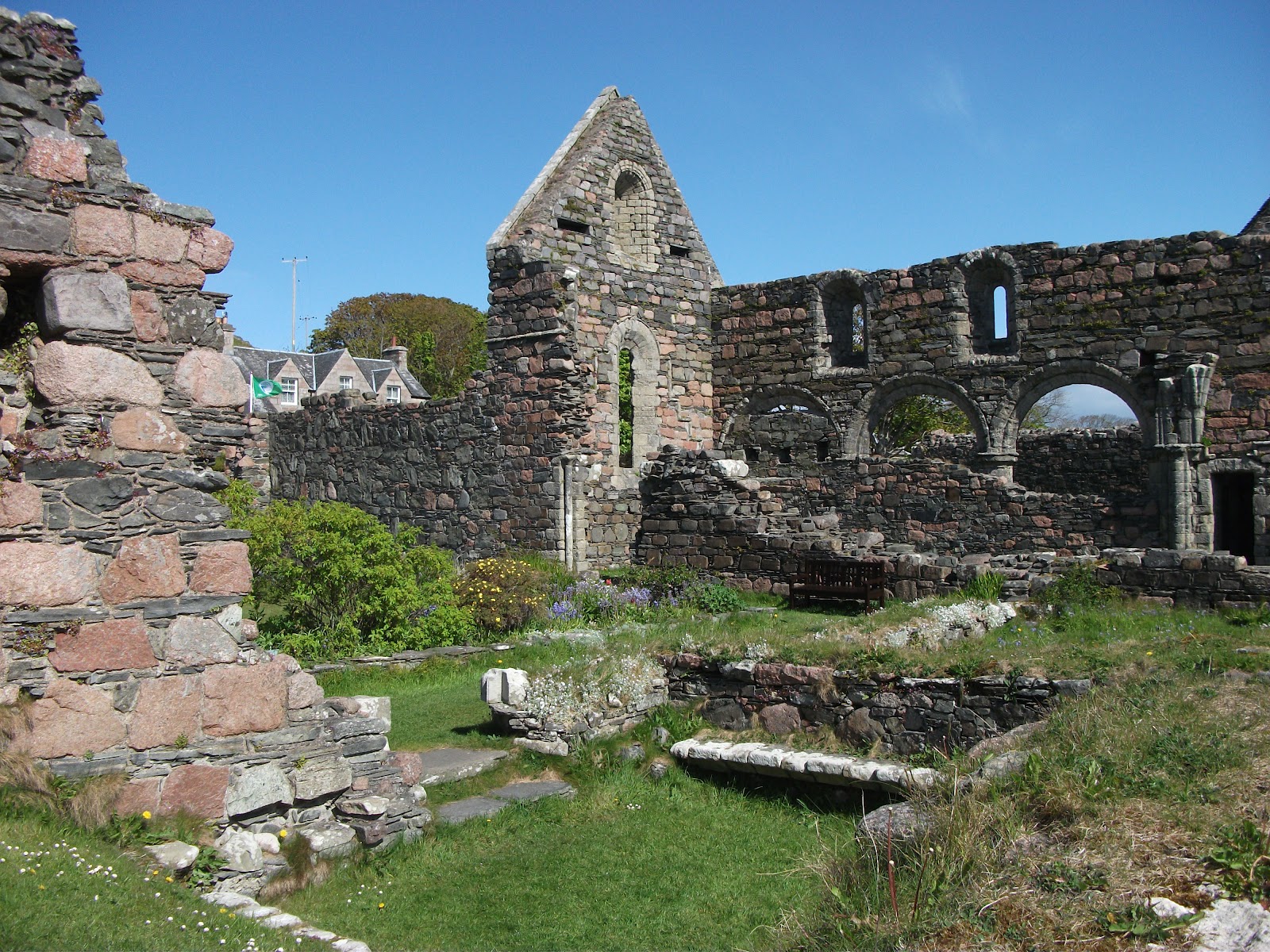
The ruins of the old Augustinian convent


An Iona bee on the ivy-leaved toadflax that grows everywhere


St Mary's Abbey


The High Cross at the Abbey


The Cloisters


Inside the Abbey Church


Today's reading is John 15.18-21...


The High Altar


Ferns in the chancel wall!


The font - the legs are of Iona marble


Gardens in Baile Mor


Bishop's House, the Anglican retreat house


An old cat in the sun...


The post box

Baile Mor from the beach, with the Abbey behind