Friday, June 29, 2012

Not seeing in the dark...

The path of descent is the path of transformation. Darkness, failure, relapse, death, and woundedness are our primary teachers, rather than ideas or doctrines...

Ladder-climbing Western culture, and the clinging human ego, made the Gospel into a message of spiritual advancement—ascent rather than descent. We hopefully do advance in “wisdom, age, and grace” (Luke 2.40), but not at all in the way we thought. Jesus again got it right! He brilliantly and personally taught the way of the cross and not the way of climbing.

We come to God much more by doing it wrong than by doing it right. God absolutely leveled the human playing field by using our sins and failures to bring us to divine union. This is surely the most counterintuitive message of the Gospels—so counterintuitive that it largely remains hidden in plain sight.

Richard Rohr, June 2012

This is hard for us to accept, or even understand. Even within the life of faith we expect to be able to say, "Every day, in every way, I am getting better and better..." We look for concrete progress in holiness, deepening commitment to church responsibilities, significant achievements in evangelism and what used to be called "corporal works of mercy". The Buddhist teacher and writer Chogyam Trungpa famously called this attitude "spiritual materialism", and we Christians are as good at it as any,

The paradox is that if we do follow Jesus on the way of the Cross, we will grow in holiness, and all the rest of it - but only so long as it is our Lord whom we're following for his own sake, and not for what we might receive. (This I think is perhaps what Jesus meant at when he said (John 6.26) that people were looking for him for what they could get.)

I know myself - but only in retrospect - that the times in my life when changes, transformations as Rohr calls them, have taken place have been low  times, times when I often haven't been able to see God's hand in events at all, but only darkness and shame and confusion. Perhaps this is what faith is: to hold on to God, to love him best of all, when nothing shows him to us, and the road is black with loss.

Sometimes, unteachable, I have wondered how to hang onto these depths of faith in the good times, like now, when all around seems to be going well, and happiness is a daily fact. It isn't possible. God knows when, and how much, we need these shadow times, these times of hollowness and pain. Even if we were able to administer this medicine ourselves, we would probably destroy ourselves. Like seeds, we can only really grow in darkness - and we can't see in the dark...

Saturday, June 23, 2012

Struggling again…

In the autumn, I wrote about some of the struggles I’d been having on high doses of steroids (for sarcoidosis) and of my hopes for some respite from the side-effects on a reduced dose. Having done quite well on a holding dose for six months, I began, three weeks ago I think, on my consultant’s advice, finally to taper off the dose altogether. I had not anticipated where this would lead…

Being on corticosteroids for a relatively long period causes the adrenal glands effectively to shut down; tapering off the dose puts one into a condition of adrenal insufficiency, the idea being that the adrenal glands will wake up to the fact that no-one is doing their work for them any more, and they had better get it together and start work again. This does not feel good for the unfortunate owner of the said glands, at all. The fatigue, aches and pains, hypoglycaemia and erratic blood pressure are bearable enough I suppose, but the psychological symptoms are a problem. Depression with teeth might be a good description. It certainly does not help creative work, blogging included.

Oddly enough, though, somewhere inside here the work goes on. God is good, always. Prayer is not only possible, but nourishing and healing in a way I find impossible to convey properly in words. And reading Cynthia Bourgeault, though very slow indeed (I can only read a few pages at a time, before they blur into visual noise and/or I fall asleep) is an adventure I wish I could do justice to here. I really do look forward to thinking through with you people some of what she has to say about apophatic vs. cataphatic prayer—and why I disagree with her about the Jesus Prayer. Pray for me for a gap in the fog so I can do just that.

Maybe simply having got this off my chest here will help, much as I hate being personal like this in public. If you are going through anything like this yourself, know this: God does not turn away. He’s in this with you, if only you will surrender sufficiently to hear his voice, feel his touch. Don’t stop praying, even when it feels pointless, barren. People sometimes say, “I can’t pray, though…” Of course you can. Anyone can repeat the words of the Jesus Prayer, or the Latin Rosary. It may not feel like it’s doing the slightest good, but that’s not the point. God is still there. He knows. Jesus promised that no-one and nothing can snatch us out of his hand (John 10.27-30). He knew abandonment and despair, because he emptied himself and became like us. But he rose in glory from the worst that could possibly happen to him, and his pierced hands are still open to each of us even now…

Lord Jesus Christ, Son of God, have mercy on me, a sinner…

Thursday, June 14, 2012

Asleep in the Mercy…

Very often the word “awakening” is used to describe the ways of God in the heart of his people (e.g. Timothy Jones’ Awake my Soul or Cynthia Bourgeault’s Centring Prayer and Inner Awakening) and of course in many ways this is a good image. God does, by his grace, wake us from the half-conscious life we live in the world, caught among images and the desire for images, living in a reality that is far from real, but a kind of user interface with reality—for, as Eliot said, “human kind / Cannot bear very much reality.”

In a recent article in Church Times, Tony Horsfall (the quote is from his recent book Rhythms of Grace: Finding Intimacy with God) wrote, “We live in a God-bathed world. There is no place where God is not, although sometimes we may be asleep in his presence.” I know what he means, and of course we have all known times like this, when we realise we have spent the entire space of the Eucharistic prayer at Mass thinking about HTML5, or the need to weed the garden. But truly being asleep, sound asleep, in the presence of God, falling asleep in the conscious presence of God, consciously longing for the mercy of Christ, and letting oneself slip into sleep as into that mercy—that is something different, and I would want to be clear about the distinction…

I seem to be collecting a little cache of writings about this, and I don’t want to repeat myself here, so do start with this Lent’s post The Shores of Perception, which links back to the earlier posts—or else just click “dreams” in the tag cloud in the sidebar. There is so much more to explore here, and yet by its very essence it is hard to capture, sitting here at a keyboard. But I will try, over the next few weeks I will try as best I can…

Tuesday, June 12, 2012

Grace abounding…

Grace—it’s a strange concept for those of us who’ve become used to the “no such thing as a free lunch” way of thinking. It seems literally to be too good to be true. We cannot believe the universe works this way, that, as Cynthia Bourgeault writes:

…you will suddenly find yourself set down in a very different universe from the one we have grown accustomed to inhabiting in these recent, post-Enlightenment centuries. Rather than living in a “clockwork” universe run on implacable scientific principles by an absentee landlord God—or, even more desolate, a totally random, nobody-in-charge universe where the only law is the law of the jungle—instead you wake up inside a warm-hearted and purposive intelligence, a coherence of which you yourself are part of the expression…

Everything is given—and this is not some theoretical, abstract theological concept, a kind of story religious people tell each other to take their minds of the cold and the dark. Nothing is of final value earned—we could never deserve that. As Richard Rohr once said,

If it's too idealized and pretty, if it's somewhere floating around up in the air, it's probably not the Gospel. We come back, again and again, to this marvellous touchstone of orthodoxy, the Eucharist. Eucharist, in the first physical incarnation in the body of Jesus, is now continued in space and time in ordinary food…

You don’t have to put spirit and matter together; they have been together ever since the Big Bang, 14.6 billion years ago (see Genesis 1.1-2 and John 1.1-5). You have to get on your knees and recognize this momentous truth as already and always so. The Eucharist offers microcosmic moments of belief, and love of what is cosmically true. It will surely take a lifetime of kneeling and surrendering, trusting and letting go, believing and saying, “How could this be true?”

It is all gift. What we need, at the very deepest level, is already there, in the open, pierced hand held out to us. And yet it is very concrete—in our sisters and brothers we know that sustaining love in very truth, warm and breathing. We have only to be broken enough to need it. And love is strong as death… it outlasts the grave, lifts the orbits of the spheres, nourishes the star-fields… it is God himself.

Wednesday, June 06, 2012

The Mercy...

Mercy is the length and breadth and height and depth of what we know of God—and the light by which we know it. You might even think of it as the Being of God insofar as we can possibly penetrate into it in this life, so that it is impossible to encounter God apart from the dimension of mercy.
The choice of term may seem a bit odd. Today “mercy”—along with so many other classic words in our spiritual tradition—has developed a negative connotation. It seems to suggest power and condescension, a transaction between two vastly unequal parties. A friend of mine, in fact, was told by her spiritual director that she should not pray the Jesus Prayer—“Lord Jesus Christ, Son of God, have mercy one me,” the mainstay of Eastern Orthodox contemplative spirituality—because “it reinforces medieval stereotypes of paternalism and powerlessness.” Modern people, this spiritual director felt, need to be told that they are worthy, “that they can stand on their own two feet before God.”
But the word “mercy” comes profoundly attested to in our Judeo-Christian spiritual heritage. Aside from the fact that the Jesus Prayer, hallowed by two millennia of Christian practice, has been consistently singled out... as the most powerful prayer a Christian can pray, we simply cannot get away from the Mercy without getting away from the Bible as well. The word confronts us at every turn, as a living reality of our faith...
Cynthia Bourgeault Mystical Hope: Trusting in the Mercy of God (Cloister Books) pp.20-22
I have to confess, without wishing to be unpleasant to Bourgeault's friend's SD, to finding the idea of standing on my own two feet before God so utterly silly as to be almost funny. This has far less to do with my own ingrained stereotypes of paternalism and powerlessness than with the odd few fleeting little glimpses of God's own Being that have been granted me over the years. The legend of King Canute on the seashore comes to mind.

Cynthia Bourgeault comes closer, in this wonderful little book, than almost anyone else I've read to describing what this way of prayer actually feels like.

Living in the Mercy, since that is what having the Jesus Prayer at the centre of one's spiritual life over al long period actually seems to be, As Bourgeault describes so well in the last few pages of Mystical Hope, we become changed, gradually, at a level which the everyday parts of our minds may come to observe, but which they can never directly access nor control. At this level, all is God's. The part of ourselves that St Paul calls σάρξ, sarx, translated variously as “flesh” (NRSV, KJV etc.) “human nature” (ISV), “sinful nature” (NIV) chunters on, doing what it does, and yet we are no longer under any obligation to take that much notice of its panics and enticements (Romans 8.12). As Bourgeault says, “Hope is not imaginary or illusory. It is that sonar by which the body of Christ holds together and finds its way. If we, as living members of the body of Christ, can surrender our hearts, re-enter the righteousness, and listen for that sonar with all we are worth it will again guide us... to the future for which we are intended. And the body of Christ will live, and thrive, and hold us tenderly in belonging.” (ibid. pp.98-99)

Tuesday, June 05, 2012

Early in the morning...

This order and discipline must be sought and found in the morning prayer. It will stand the test at work. Prayer offered in early morning is decisive for the day. The wasted time we are ashamed of, the temptations we succumb to, the weakness and discouragement in our work, the disorder and lack of discipline in our thinking and in our dealings with other people: all these very frequently have their cause in our neglect of morning prayer. The ordering and scheduling of our time will become more secure when it comes from prayer.
Dietrich Bonhoeffer, with thanks to BibleGateway
It's a strange thing, but I have found this to hold true in every circumstance and stage of life. It doesn't get less true as one moves into contemplative ways of praying: somehow it applies even more keenly in the wide lands of silence and stillness.

Saturday, June 02, 2012

Iona

I've been sorting out some pictures...

Walking to the ferry at Fionnphort, on the Isle of Mull


Landed!


Baile Mor, Iona's village


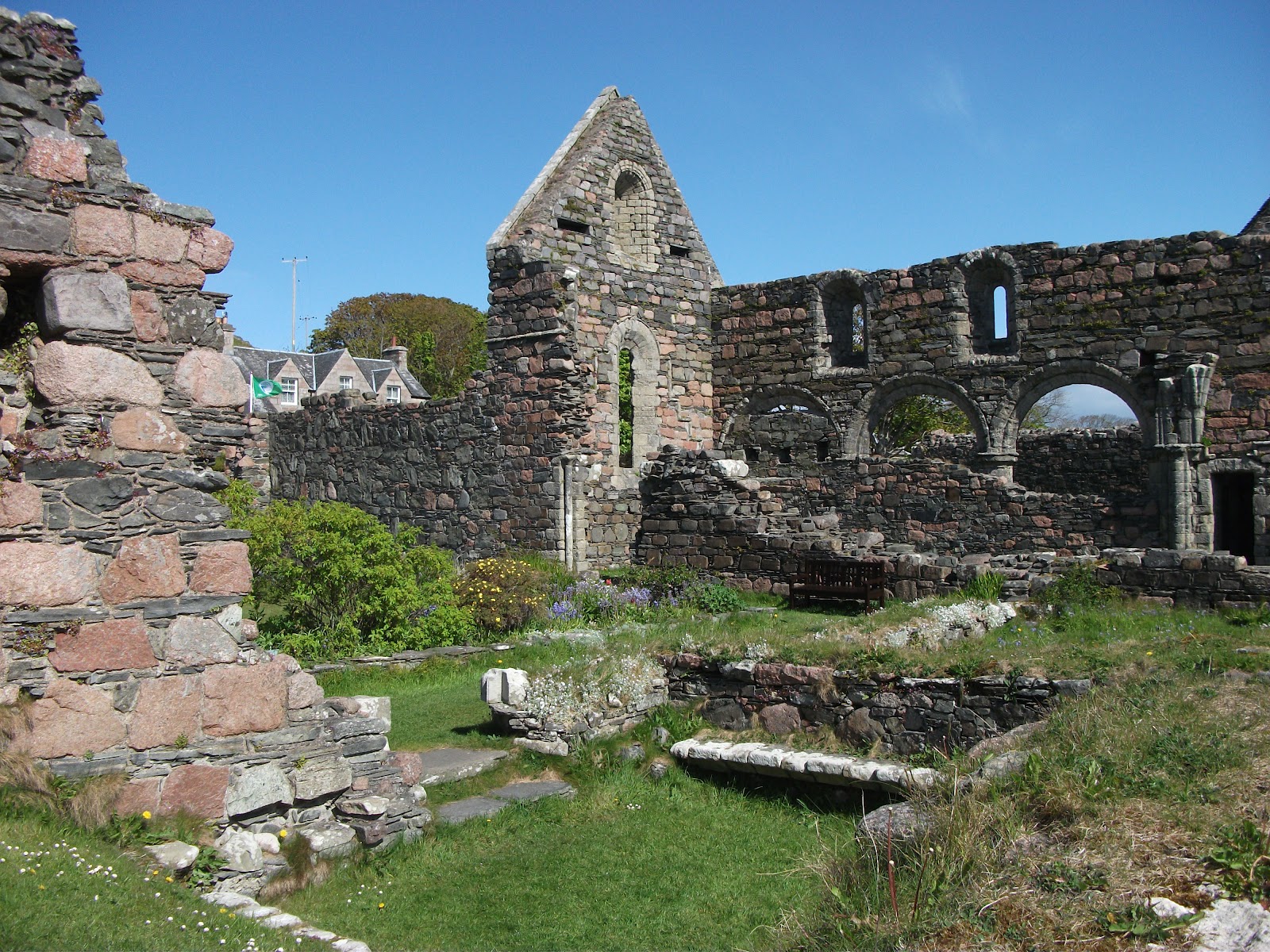
The ruins of the old Augustinian convent


An Iona bee on the ivy-leaved toadflax that grows everywhere


St Mary's Abbey


The High Cross at the Abbey


The Cloisters


Inside the Abbey Church


Today's reading is John 15.18-21...


The High Altar


Ferns in the chancel wall!


The font - the legs are of Iona marble


Gardens in Baile Mor


Bishop's House, the Anglican retreat house


An old cat in the sun...


The post box

Baile Mor from the beach, with the Abbey behind

Thursday, May 31, 2012

Poor in spirit…

May has been an odd month—in many ways scattered, through being away so much (we’ve just returned from hearing Cynthia Bourgeault speak in London)—but a glorious month too, full of beauty and discovery, and moments of extraordinary illumination that I cannot take the least credit for… but I have little time to organise any remotely coherent thoughts for this blog.

I have been typing up some notes on Cynthia Bourgeault, and trying to let her words settle into the frame of the rest of the month. As things gradually become clear, I’ll try and share some of them here over the next week or so.

Meanwhile, a couple of passages of Scripture that have haunted me this last couple of days:

Let the same mind be in you that was in Christ Jesus, who, though he was in the form of God, did not regard equality with God as something to be exploited, but emptied himself, taking the form of a slave, being born in human likeness. And being found in human form, he humbled himself and became obedient to the point of death--even death on a cross. Therefore God also highly exalted him and gave him the name that is above every name, so that at the name of Jesus every knee should bend, in heaven and on earth and under the earth, and every tongue should confess that Jesus Christ is Lord, to the glory of God the Father.

Philippians 2.5-11

Blessed are the poor in spirit, for theirs is the kingdom of heaven.

Matthew 5.3

Tuesday, May 22, 2012

Le Point Vierge

Back from Mull and Iona, I've been trying to catch up on things, with varying degrees of success...


At the center of our being is a point of nothingness which is untouched by sin and by illusion, a point of pure truth, a point or spark which belongs entirely to God, which is never at our disposal, from which God disposes of our lives, which is inaccessible to the fantasies of our mind or the brutalities of our own will. This little point of nothingness and of absolute poverty is the pure glory of God in us. It is so to speak His name written in us, as our poverty, as our indigence, as our dependence, as our sonship. It is like a pure diamond, blazing with the invisible light of heaven. It is in everybody, and if we could see it we would see these billion points of light coming together in the face and blaze of a sun that would make all the darkness and cruelty of life vanish completely.
Thomas Merton, Conjectures of a Guilty Bystander, p. 158

Merton's vision of the point vierge has been haunting me recently. Cynthia Bourgeault quotes this very passage, tying it to the sense of the present mercy of God, the hope that lies deeper than all fear and doubt, at the very bedrock of being itself (Romans 8.28-39).

We are waiting, with the first disciples, for Pentecost. Christ has gone before us, as he promised (John 17.11-13). His promised Holy Spirit (John 16.7-15) will come upon them, and unimaginable consequences (the Acts of the Apostles, and all history since then) will follow. Since then, each of us has had the means (Romans 8.24-27) to observe, inwardly, that "point or spark which belongs entirely to God."

There are many ways to that vision; or should I say there are many ways to wait for God to reveal it to us, since it "is inaccessible to the fantasies of our mind or the brutalities of our own will." For Bourgeault it seems to be centring prayer; for me, as it has been for years, it is the Jesus Prayer. Its words, "Lord Jesus Christ, Son of God, have mercy on me, a sinner," contain precisely that waiting, that emptiness that is the contemplative precondition itself.

The kind of awareness that the Jesus Prayer may lead us to is very simple... We believe – we know by faith – that God in Christ is here, with us and in us. Our task is to try to remember him and be attentive to him. It is this attentiveness that is the door to our experience of the presence of God. We cannot summon this experience at will. It is, like the Prayer itself, a gift. Ours is only a discipline of faith and perseverance. The experience, when it comes, will come of its own accord, and will be nothing like what we could ever imagine. God is immensely bigger than our imagination... And then, at last, we shall know what we longed and hoped for all these years when we called on Jesus' name again and again. 
Irma Zaleski, Living the Jesus Prayer, pp.30-31
The words of the prayer, too, contain within them that constant sense of trust in the mercy of God in Christ that Bourgeault sees so clearly. In Zaleski's words (ibid., pp.52-53) we meet God alone:

In a very real sense, we can only pray within the Church. When we say "Jesus," and ask for his mercy, we ask on behalf of his whole body, the Church, and by implication, on [behalf of] every human being who has ever lived. (See also Romans 8.12)
On the other hand, because the Jesus Prayer is a prayer of repentance, a prayer of a sinner, it must also be a prayer of each one alone... In the final analysis, we must make our own individual peace with God, find our own relationship with Christ, meet him face to face. Nobody can do it for us...

Wednesday, May 09, 2012

Hiatus…

Sorry for the (temporary, I promise) hiatus in blogging here… just very busy one way or another. I’ll be back before you know it. Meanwhile, here is something I found beautiful:

At this time in history, the contemporary choice offered most Americans is between unstable correctness (liberals) and stable illusion (conservatives)! What a choice! It has little to do with real transformation in either case. How different from the radical orthodoxy of T. S. Eliot, who can say in Little Gidding,

You are not here to verify,
Instruct yourself or inform curiosity
Or carry report. You are here to kneel . . . .

There is a third way, and it probably is a way of “kneeling.” Most people would just call it “wisdom.” It demands a transformation of consciousness and a move beyond the dualistic win/lose mind of both liberals and conservatives. An authentic God encounter is the quickest and truest path to such wisdom, which is always non-dual consciousness and does not take useless sides on non-essential issues…

Read my favourite mystic, Julian of Norwich (1342-1420), and she will show you how to be a most traditional Christian, while breaking all the rules and orthodox ideas at the very same time. On the night of May 8, 1373, God "showed himself" to her and it took her more than twenty years to unpackage the experience. This English laywoman well deserves to be a doctor of spirituality. Her Revelations of Divine Love is a bottomless well of wisdom, love, and truth, and one of the few books I could return to every month and find something new—which, for me, is a sign of perennial and radical orthodoxy.

Richard Rohr, adapted from Contemplation in Action

Friday, May 04, 2012

Just letting it go...


To pray contemplatively is to abandon one’s idea of how and why it all works: God, justice, or prayer. It is to abandon ourselves to trust in the living presence and reality of the divine, mysteriously at work within the darkness of the human condition - a living presence apparently not in the business of straightening out everything we would do, or to our specifications.
Patricia Loring, with thanks to Greenpatches

Mercy is all we are given...

It seems to me, when things are quiet, that perhaps mercy is all we are given, all we have to give. I'm certain that this is at least one way in which we are made in the image of our God. All we are comes down to this...
He has shown you, O mortal, what is good.
    And what does the Lord require of you?
To act justly and to love mercy
    and to walk humbly with your God.
Micah 6.8 NIV

We are not supposed, with the greatest respect to the theologians, to be able to work it all out. Psalm 131 is closer, "O LORD, my heart is not lifted up, my eyes are not raised too high; I do not occupy myself with things too great and too marvellous for me." (v.1)

Mercy is not an easy word to to pin down. It is in the very heart and essence of God, his steadfast love and his faithfulness. As we pray for his mercy, in solidarity, identification, with all that has been made, all our lovely and broken sisters and brothers, human and otherwise, we become through our prayer a part of this everlasting verb that is our Christ...

Lord Jesus Christ, Son of God, have mercy on me, a sinner...

Wednesday, May 02, 2012

Still thinking about Simone Weil…

God is not an object. How can we expect to test for his presence, expose him to investigation? He holds in the palm of his hand—or so we understand it—all that he has made. How could he be within it, susceptible to perception? Only the Incarnation makes possible the touch on the shoulder, the pierced hand against the tunic, bread and wine—that and the frail aerials of the prophets, picking up, through the hiss and stutter of culture and common knowledge the unmistakable signals of the Spirit…

All else, in our time, is as Eliot saw

…hints and guesses,
Hints followed by guesses; and the rest
Is prayer, observance, discipline, thought and action.

(Four Quartets: The Dry Salvages)

Lord God, give us grace to persevere, discipline to keep on…

I have gone astray like a lost sheep; seek out your servant, for I do not forget your commandments. (Psalm 119.176)

Sunday, April 29, 2012

Good Shepherd Sunday

Jesus answered, ‘I have told you, and you do not believe. The works that I do in my Father’s name testify to me; but you do not believe, because you do not belong to my sheep. My sheep hear my voice. I know them, and they follow me. I give them eternal life, and they will never perish. No one will snatch them out of my hand. What my Father has given me is greater than all else, and no one can snatch it out of the Father's hand. The Father and I are one.’

(John 10:25-30)

Today is one of my favourite days in the church calendar. I find the image of our Lord as shepherd, and of ourselves as sheep, extraordinarily moving and reassuring. The mercy of Christ is just particularly that—we are foolish, and we get lost; he finds us, holds us, regardless of what may be thrown at us, regardless of all we fear, and think we perceive…

No testing has overtaken you that is not common to everyone. God is faithful, and he will not let you be tested beyond your strength, but with the testing he will also provide the way out so that you may be able to endure it.

(1 Corinthians 10:13)

Thursday, April 26, 2012

In a stew...

I've been thinking a bit about the news reports that have been dominating reports about the church recently: the "fight" (the Guardian's word) to become the next Archbishop of Canterbury, the appalling treatment of the Leadership Conference of Women Religious in the USA, the latest threats from the hard men of GAFCON, and where that leaves the ordinary Christian, trying to "to do justice, and to love kindness, and to walk humbly with [their] God..." (Micah 6.8)

While I was thinking about this, I stumbled on an excellent post by Greenpatches, which pointed me back to Richard Rohr's Falling Upward. Rohr says (pp.74-75):

A crucible, as you know, is a vessel that holds molten metal in one place long enough to be purified and clarified. Church membership requirements, church doctrine, and church morality force almost all issues to an inner boiling point, where you are forced to face important issues at a much deeper level to survive as a Catholic or a Christian, or even as a human. I think this is probably true of any religious community, if it is doing its job. Before the truth "sets you free," it tends to make you miserable.

The Christian truth, and Jesus as its spokesman, is the world-view that got me started, that formed me and thrilled me, even though the very tangent that it sent me on made me often critical of much of organised Christianity. In some ways, that is totally as it should be, because I was able to criticise organised religion from within, by its own Scripture, saints and sources, and not merely cultural, unbelieving or rational criteria. That is probably the only way you can fruitfully criticise anything, it seems to me...

Eventually... Catholicism became for me, and I think as it has for many, a crucible and thus a unified field. Which is why it is very hard to be a "former" Catholic, once you really get its incarnational and inherently mystical world-view...

For all its failures, it is no surprise that the Catholic world-view (note that I am not saying the "Roman" world-view) continues to produce Teilhard de Chardins, Mother Teresas, Thomas Mertons, Edith Steins, Cesar Chavezes, Cory Aquinos, Mary Robinsons, Rowan Williamses, Desmond Tutus, and Dorothy Days. I like to call it "incarnational mysticism." Once you get it, there is no going backward, because nothing is any better.
This is really an extraordinary insight. If Rohr is right, and generations of religious (and others) seem to testify that he is (just think of St Francis, or St Teresa of Avila) then we don't need to worry, for ourselves, about these troubles - perhaps not even about the inevitable pain and even anger that arise in us when we read yet another report of strife within the body of Christ. As St Paul said, "We know that all things work together for good for those who love God, who are called according to his purpose." (Romans 8.28)

It's worth remembering another passage of Scripture, though. "Jesus said to his disciples, 'Occasions for stumbling are bound to come, but woe to anyone by whom they come!"  (Luke 17.1)

Wednesday, April 25, 2012

On feeling speechless…

Stuck at home with a cold, I’ve been trying to decide why I've been finding it so hard to post anything here this last week or so. Perhaps it is partly post-Easter fatigue, rather like the dead spot in January after the glory of Christmas and the new start of another year. Maybe it has to do with something described wonderfully well in the back page interview in this week's Church Times.

John Brassington, Chair of Dance into Worship, says in his interview, quoting a letter he received from Canon Joseph Poole, the first Precentor of the rebuilt Coventry Cathedral,

...You will fulfil your vocation chiefly by prayer; and specifically by adoration (for which you have a special aptitude) and by intercession. There are many, many people... who need your intercession. What you will do for people, in adoration and intercession, you will probably never know, and nor will they. Only the Father knows—and that is all that matters...

One could apply those sentences to me, I think, and to many who have been called along the same path, only perhaps adding the word contemplation. Sometimes words simply fail. I think at times the act of cognition itself fails. We pray, but we feel nothing, we are aware of nothing but ordinariness and a sense of being anything but special, or useful. At times like this, words like Canon Poole’s do more for me, really, than anything…

Wednesday, April 18, 2012

Simples?

The whole spiritual life can be reduced in practice to one simple formula: doing the will of God.
Thomas Merton, Ascent to Truth
It’s interesting to consider, though, if this is the case, how important must be the discernment of God’s will.

St Francis, of course, listened keenly to God’s voice—and yet even he, at least when young, got it wrong. He interpreted God’s word about the armour marked with the Cross as predicting his knightly success, and later he took Christ’s words from the San Damiano crucifix, “Go, Francis, and repair my house, which as you see is falling into ruin…” as referring to the building, and not to Holy Church herself.

St Ignatius of Loyola considered discernment impossible without a spiritual director.
No one who is trying to make spiritual progress should attempt to do so alone - a spiritual director is required. A director assists a Christian in examining the motives, desires, consolations, and desolations in one's life. Objectively, one can know what is right from looking at the Ten Commandments and the Seven Deadly Sins in a thorough examination of conscience. But the broader picture of one's life is often not so clear. A Christian should, according to St. Ignatius, share everything with a director who can see things objectively, without being swayed by the emotions or passion. Discerning whether the good spirit (the influence of God, the Church, one's soul) or the bad spirit (the influence of Satan, the world, the flesh) is at work requires calm, rational reflection. The good spirit brings us to peaceful, joyful decisions. The bad spirit often brings us to make quick, emotional, conflicted decisions. A spiritual director can assist both by personal experience, listening with care, and giving an objective analysis.
St Paul (1 Corinthians 12.10) placed great emphasis on prayerful intuition, and seems to have lived by it himself (e.g. Acts 16.6-10), while John (1 John 4.1-3) seems to have proposed a creedal formula. The writer to the Hebrews, perhaps more helpfully, suggests measuring everything against Scripture (Hebrews 4.12-13).

For myself, regular readers of The Mercy Blog won’t be surprised that I most often simply give up attempting to “work it out”, and resort to the Jesus Prayer, holding my own ignorance of God’s will up, as it were, to his Son’s own merciful discernment:

Lord Jesus Christ, Son of God, have mercy on me, a sinner…

Sunday, April 15, 2012

Slowly…

Reading often means gathering information, acquiring new insight and knowledge, and mastering a new field. It can lead us to degrees, diplomas, and certificates. Spiritual reading, however, is different. It means not simply reading about spiritual things but also reading about spiritual things in a spiritual way. That requires a willingness not just to read but to be read, not just to master but to be mastered by words. As long as we read the Bible or a spiritual book simply to acquire knowledge, our reading does not help us in our spiritual lives. We can become very knowledgeable about spiritual matters without becoming truly spiritual people.

As we read spiritually about spiritual things, we open our hearts to God's voice. Sometimes we must be willing to put down the book we are reading and just listen to what God is saying to us through its words.

Henri Nouwen, from Bread for the Journey

I sometimes feel obscurely guilty about how long it takes me to get through a spiritual book, as compared with a novel, or something technical, and yet I’ve also often felt that this was the only way for me. I should have the courage of my convictions more often—it’s a besetting problem of mine, not having said courage—and simply admit that this is God’s way of telling me to eat slowly, and chew every mouthful…

Saturday, April 14, 2012

Comments?

I’m always struck by the disparity in the number of comments different blogs receive. It doesn’t seem to have much to do with readership, to judge by the numbers of subscribers on Google Reader, and—perhaps more significantly—the number of readers recorded (in Blogger stats) for each post here on The Mercy Blog (TMB).

I’m not complaining, by the way, about being neglected by my non-commenting readers—I am always slightly astonished to see how many of you there are out there! It just bewilders me a little that there is such a range of responses. Some blogs hardly ever receive a comment, while some seem to attract many comments, which develop into long conversations—heated, sometimes!—with both casual visitors and those who are evidently regulars. Of course, some bloggers are more punctilious about replying to comments than I am, but still it doesn’t seem to matter that much. For example: there’s a minimalist blogger I read sometimes, who has less Google Reader subscribers than TMB, but her posts rarely seem to have less than 25 comments—sometimes 125—and yet there’s a Franciscan friar and author I read regularly who has far more subscribers on Google Reader, and who receives about the same, or maybe slightly less, comments as TMB.

Some bloggers have closed comments altogether, some have open commenting (and often trouble with trolls and spam as a result) while others, like me, have enabled comment moderation and CAPCHA, It makes (apart from the closed blogs of course) little difference to the amount of comments they receive, seemingly.

Perhaps here is a field for research into the sociology of blogging…

Thursday, April 12, 2012

Christ the mercy of God…

Mostly we think of people with great authority as higher up, far away, hard to reach. But spiritual authority comes from compassion and emerges from deep inner solidarity with those who are “subject” to authority. The one who is fully like us, who deeply understands our joys and pains or hopes and desires, and who is willing and able to walk with us, that is the one to whom we gladly give authority and whose “subjects” we are willing to be.

It is the compassionate authority that empowers, encourages, calls forth hidden gifts, and enables great things to happen. True spiritual authorities are located in the point of an upside-down triangle, supporting and holding into the light everyone they offer their leadership to.

Henri Nouwen, from Bread for the Journey

Sometimes I think that mercy is all that matters in the universe, ultimately. Easter shows us, if it shows us anything, that the mercy of Christ is the pivot on which all things turn. In the death of Christ, the very sun’s light was dimmed; in his Resurrection, all things are made new.

We don’t know the source of the very early hymn the Apostle Paul quoted in Philippians 2.6-11, but it perfectly sums up our Lord Jesus, the Son and the mercy of God, who

though he was in the form of God,
did not regard equality with God
as something to be exploited,
but emptied himself,
taking the form of a slave,
being born in human likeness.
And being found in human form,
he humbled himself
and became obedient to the point of death—
even death on a cross.

Therefore God also highly exalted him
and gave him the name
that is above every name,
so that at the name of Jesus
every knee should bend,
in heaven and on earth and under the earth,
and every tongue should confess
that Jesus Christ is Lord,
to the glory of God the Father.